
TL;DR
Swift postponed the structured address deadline and, at Sibos, told banks not to wait. Use the time to do it right, once and fully — compliance gains most.
Score your live traffic, map corridor exposure, and pick the first sprint — before the next date lands.
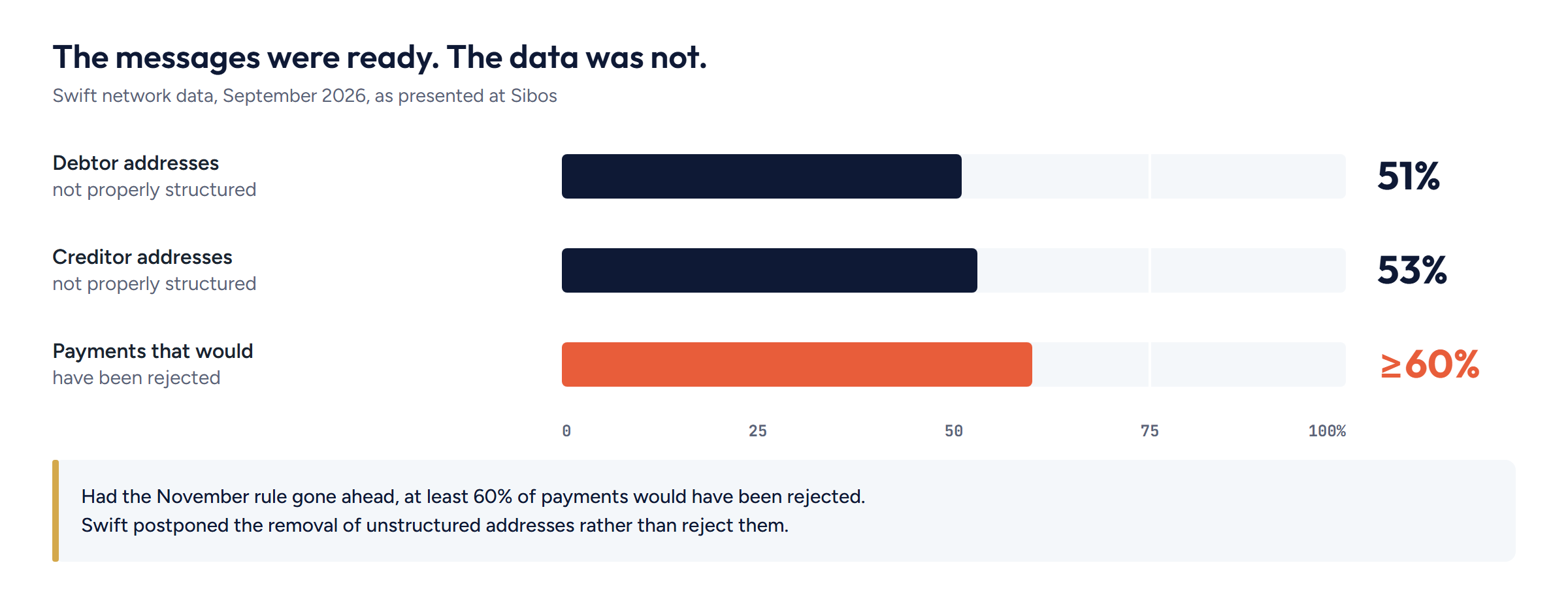
In September, 51% of debtor addresses and 53% of creditor addresses on the Swift network were not properly structured, according to Swift network data cited at Sibos 2026. Had the November rule gone ahead, at least 60% of payments would have been rejected.
So Swift postponed the ISO 20022 structured address deadline. Then, across three sessions in three days, three of its senior executives told the industry the same thing in different words: don't wait.
They're right, and not only because Swift says so. A deadline pushes every programme toward the minimum: populate the field, pass the validator, close the ticket. The postponement lifts that pressure for long enough to do something better — to do it right, do it once and do it fully. The banks that use the time that way will get the most out of it, and most of all in compliance.
Here is where things stand, why the date moved, what Swift asked of banks, and how to spend the time.
I write Resolved!, a fortnightly newsletter on ISO 20022 address data for payments, compliance and data leaders. Subscribe →
Where the ISO 20022 structured address deadline stands
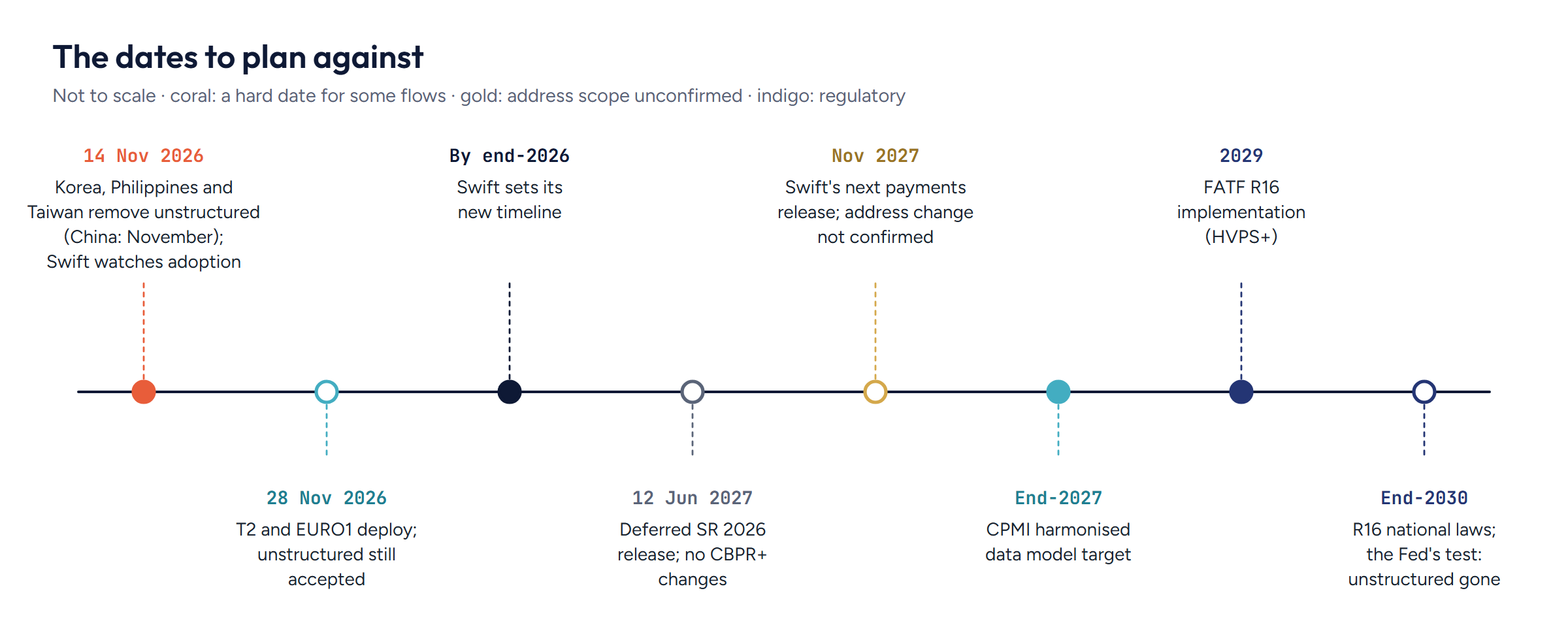
There is no new Swift date yet. Swift says it will define a new timeline by December 2026. Until then there is "no mandatory requirement" to use structured or hybrid addresses — and, in the same notice, Swift says institutions "should strive to adopt these address formats now." The ISO 20022 address requirements haven't changed. Their date has.
| Where it stands | |
|---|---|
| SR 2026 on 14 November 2026 | Will not proceed on Swift. Swift calls it a "controlled extension". The requirement is "rescheduled, not abandoned" |
| A new Swift date | None yet. A new timeline by December 2026 |
| November 2027 | Swift's next payments release. Swift has not confirmed the address change will be in it |
| 12 June 2027 | The deferred SR 2026 release, for securities, funds and non-payment MT messages. No CBPR+ changes. Not the new deadline |
| In the meantime | Structured and hybrid addresses are "already supported as part of SR 2025". No new release is needed to start |
| FATF Recommendation 16 | National laws by the end of 2030. Market infrastructures plan to implement it in 2029 |
Sources: Swift KB 6001119 and Swift's notice of 21 September 2026; FATF; HVPS+ at Sibos 2026. Status as checked 7 October 2026 and re-checked on the morning of publication.
Two lines cause most of the confusion. 12 June 2027 is not your deadline: it carries no CBPR+ changes. November 2027 is a possibility, not a promise: seventeen market infrastructures say they will align with Swift on it, but nobody has said the address change will be in it.
Doing nothing is not the safe option. Swift recommends uninstalling SR 2026 FINplus and Funds Universal Standards Archive packages from production: "Failure to remove these packages could lead to service disruption in November 2026 or later because the Universal Standards Archive contains an activation date after which it becomes active automatically." Swift's guidance and the affected packages are in Knowledge Centre article 6001119 (swift.com login may be required).
14 November is still a deadline in four corridors
On the Swift network, nothing changes on 14 November. In four markets, the original ISO 20022 November 2026 deadline stands. According to the overview PMPG published with HVPS+ and Swift (status as at 6 September), BOK-Wire+ in Korea, PhilPaSSplus in the Philippines and FISC in Taiwan remove fully unstructured addresses on 14 November 2026, and CIPS in China does so in November.
PMPG's market practice gives the consequence in one line: "The destination PMI may reject a payment where the fully unstructured postal-address option is no longer accepted." Each rejection becomes a repair, a return or an investigation, at the $25–50 per exception we have used throughout our published cost work.
Europe made two decisions, not one. The European Payments Council delayed the end of unstructured addresses in its SEPA schemes and will set a new date at its October board. The Eurosystem and EBA CLEARING deploy their T2 and EURO1 release on 28 November and will keep accepting unstructured addresses.
PMPG's overview, published with HVPS+ and Swift, lists 26 infrastructures and the position each has published. No list covers your correspondents, so ask each one: what will you accept, what will you reject, and what will you do with an address you can't parse — repair it, return it, or pass it on?
Why Swift postponed: the messages were ready, the data wasn't
The numbers made the decision. Swift's chief operations officer called it risk-led, taken after part of the community asked for more time. Going ahead, as the head of ISO 20022 at Federal Reserve Financial Services put it, would have been lose-lose: mass rejections, or poor data forced into structured fields just to pass validation.
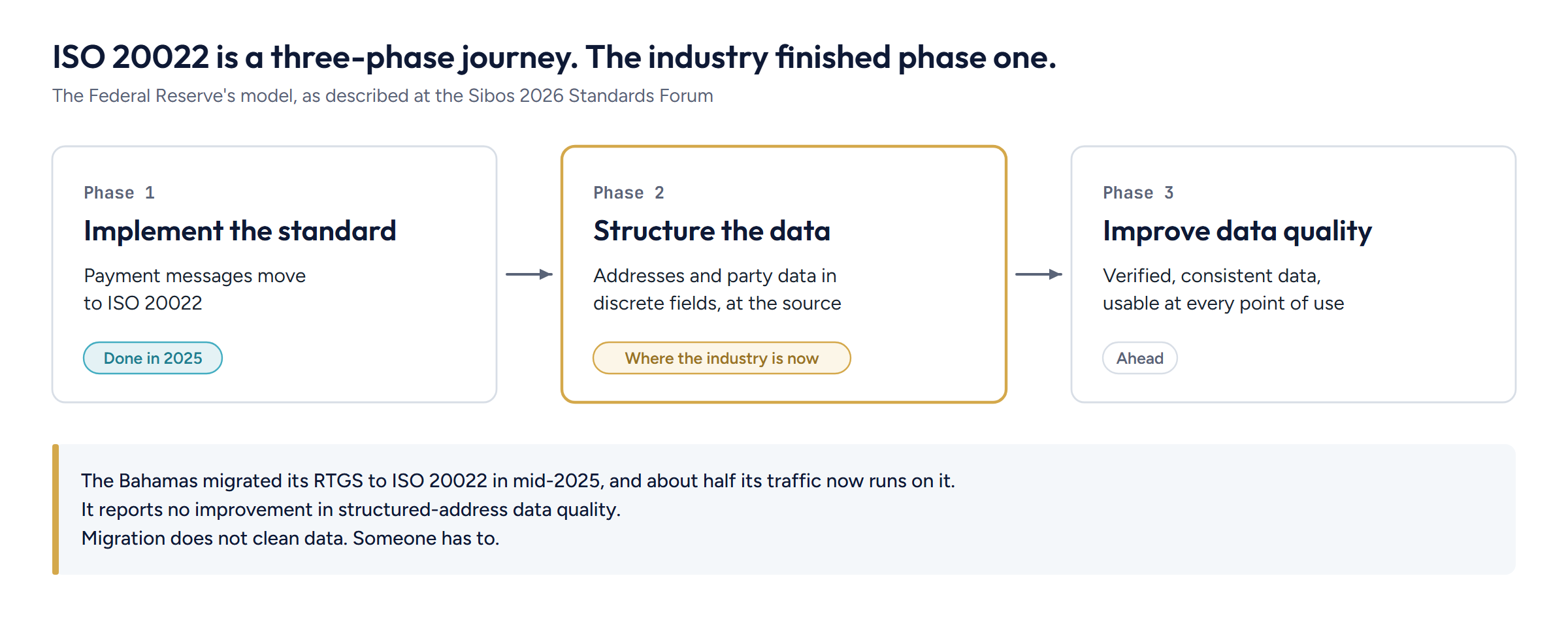
Swift's own diagnosis was more striking than its numbers. Swift's head of the ISO 20022 programme asked whether the industry had focused on message readiness rather than data readiness. The Fed's ISO 20022 lead described a three-phase journey: implement the standard, structure the data, then improve its quality. The industry finished phase one when cross-border payments moved to ISO 20022 in 2025. It wasn't ready for phase two.
The reasons the panels gave had nothing to do with schemas:
- The data lives outside payments, in onboarding, KYC, core banking and corporate ERP systems. One bank that was ready for November still had to change 250 back-office systems to get there.
- Hybrid gave false comfort. It still needs town and country, and on the creditor side that data belongs to the client's clients.
- Corporates were reached last, and were told the change was for sanctions screening.
- Everyone depends on the same vendors, so when they slip, everyone slips.
Over thirty years in payments compliance, I have seen the same pattern in every migration: the format moves on the date; the data moves when someone owns it. The Central Bank of The Bahamas showed it at Sibos. It migrated its high-value payment system to ISO 20022 in mid-2025, about half its traffic now runs on the new messages, and it reports no improvement in structured-address data quality. Migration doesn't clean data. Someone has to.
Our record, including the part that did not hold
In March we called this "a data-quality problem wearing a messaging costume." In June we set 97% of traffic on the new MX messages against roughly 60% of addresses still unstructured.
On 6 August, in Resolved! Issue 8, I published the headline "62% of Payment Messages Will Fail the ISO 20022 Deadline on 15 November 2026." The 62% was our own estimate. Swift's September data put the share of payments that would have been rejected at 60% or more: a different method, the same order of magnitude. The date in that headline did not hold. We called the failure mode. We did not call the timing.
What Swift told banks at Sibos: don't wait
The most consistent message at the Sibos Standards Forum came from Swift itself, and it matched what Swift had already put in writing on 21 September: financial institutions "should strive to adopt these address formats now." On stage, three of its executives said the same thing in their own words:
- Swift's chief operations officer, who leads its ISO 20022 work: don't wait for the next deadline. Structured addresses are supported today on all networks, and institutions that are ready should go ahead without waiting for the rest of the community.
- A senior Swift standards executive: if you are ready, switch it on, because every institution that does helps the rest of the industry and builds confidence in the change.
- Swift's chief executive for the UK and Ireland: same destination, new timeline — institutions can send hybrid and structured addresses today.
There's a reason beyond encouragement. Swift's chief operations officer said that next time, adoption should show on the network before a change becomes mandatory, with readiness criteria and soft validation first, and Swift will be watching adoption around 14 November, hoping to see it climb sharply. If the next date depends on what Swift sees, the banks that switch on now are writing the evidence it will be set on.
How much time is there? Speakers proposed three-to-five-year roadmaps in place of a new date every year. But four corridors go live in November, FATF Recommendation 16 (R16) will be implemented in 2029, and the Fed's test is that unstructured addresses are gone by 2030. You have more time than you had in August. You don't have as much as it looks.
Score your live traffic, map corridor exposure, and pick the first sprint — before the next date lands.
Use the time to do it right, do it once and do it fully
The deadline was the strongest force pushing programmes toward the minimum. That force has eased. PMPG put the alternative in a sentence I'd pin above any programme board: "Additional time only creates value if it is used to improve readiness." Here is what that looks like, in three tests.
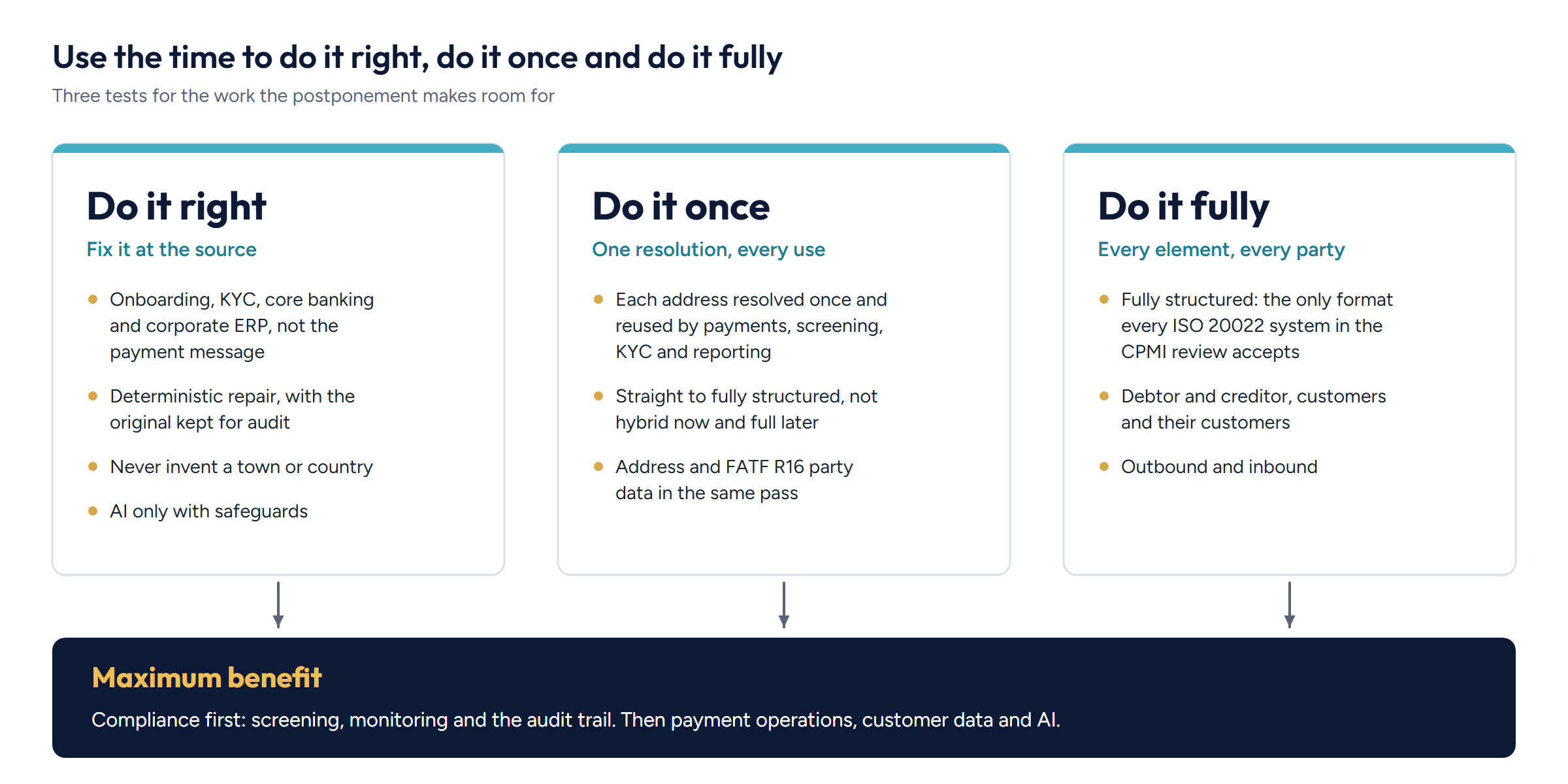
Do it right: fix it at the source
The address isn't created in the payment message. It's captured at onboarding, held in KYC and core banking and, for most beneficiaries, typed into a corporate's ERP — and, as a PMPG representative put it at Sibos, the further from the source you fix data, the more it costs. Fix it where it lives, to a written standard: PMPG's September market practice says a repair should be "deterministic, transparent", with the original "retained for audit and investigation purposes", and no town or country created or assumed where it can't be reliably identified.
In flight today, at rest once. Fixing it at the source doesn't mean waiting for the source. Resolve every payment in flight now, so nothing of yours is rejected in November, and remediate the records at rest once and fully, so the in-flight repair is needed less every month. The two run in parallel, on different teams, and the second is what makes the first temporary.
AI can help, but it doesn't replace structured data. On the Sibos AI panel, speakers agreed that 99.9% accuracy isn't good enough in payments, where one wrong country value can create a compliance issue. Their safeguards are a fair test for any tool: the same input gives the same output, it reports its confidence, it leaves a field blank rather than guess, and a person reviews the result.
Do it once: one resolution, every use
Every part of the bank asks something different of the same address: payments need the destination system's format, screening an exact country and town, KYC provenance, master data a key that deduplicates. Fix it separately at each point of use and you fix it eight times, eight slightly different ways. Resolve it once, keep the original, and let every system use the same answer.
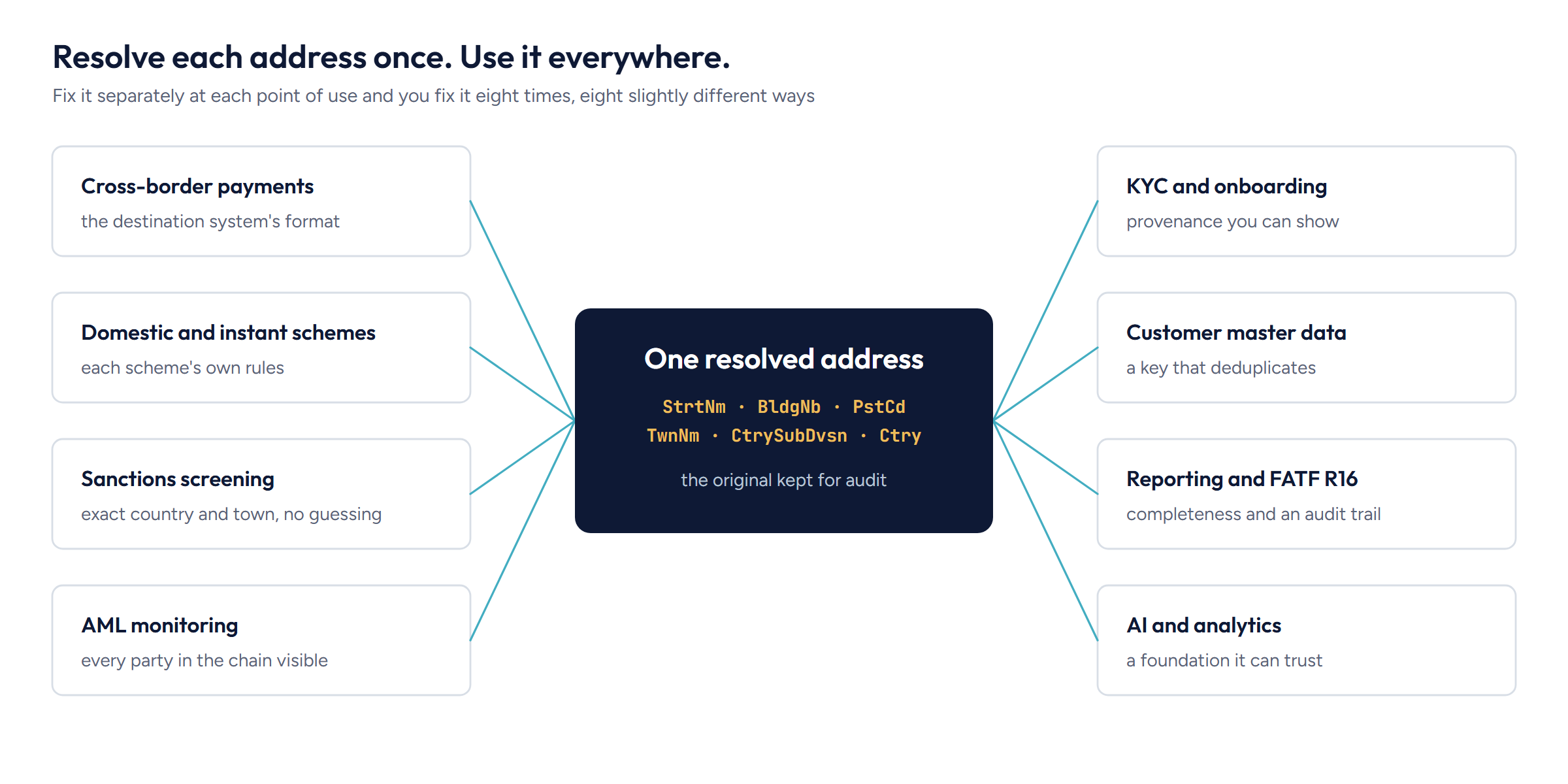
Doing it once also means not doing it twice. The Central Bank of The Bahamas told its market to go straight to fully structured, because hybrid first would double the work; about 22% of its participants are already there. The Fed's ISO 20022 lead agreed: there is no need to stop at hybrid.
And it means doing the R16 party data — natural or legal person, date of birth or LEI — in the same pass, for implementation in 2029. You will open the same customer records either way. Open them once.
Do it fully: every element, every party
Fully structured is the format that works everywhere. In the CPMI's February 2026 review of 48 payment systems, it was the only address format every ISO 20022 system accepted. Seven systems built on Swift's ISO 20022 Accelerator Pack — in Hungary, Angola, Botswana, Ghana, Tanzania, Uganda and Zambia — took fully structured or fully unstructured addresses, but not hybrid, and had no date to add it.
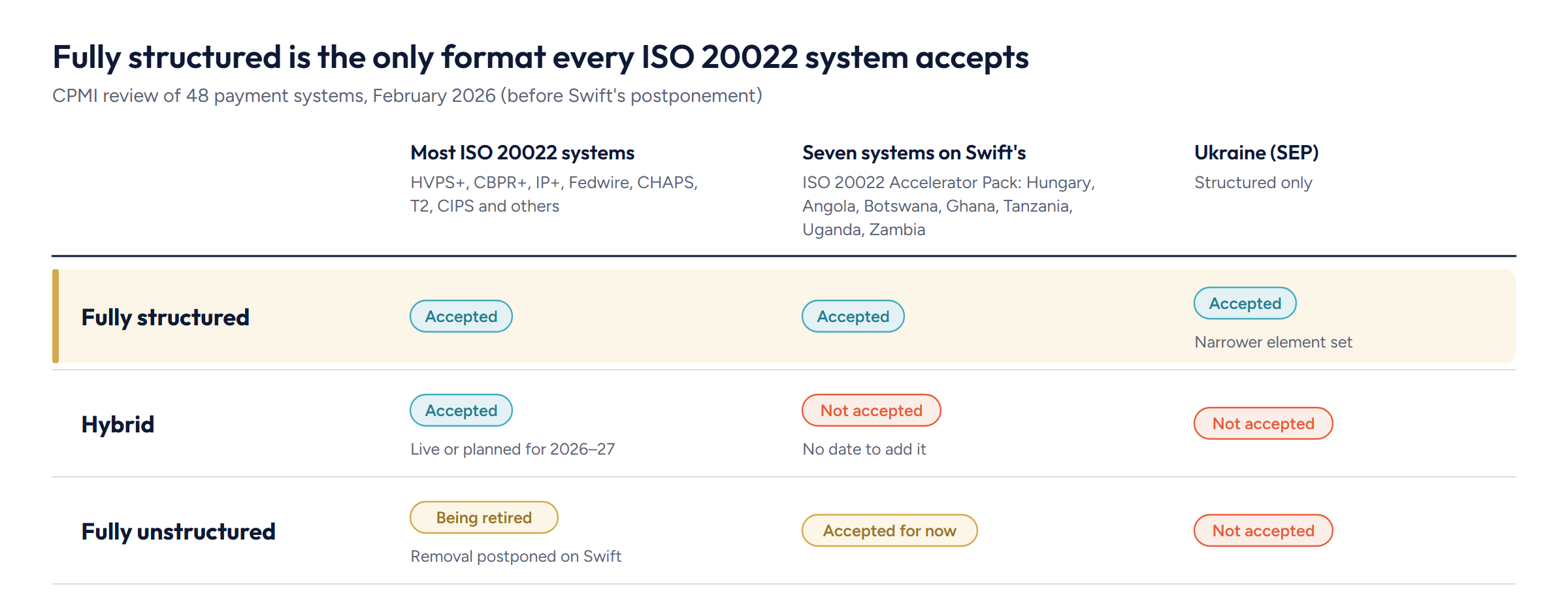
That produces an odd result. Hungary's VIBER and Zambia's ZIPSS are among the infrastructures keeping unstructured addresses until November 2027, yet the CPMI recorded neither as accepting hybrid. In those systems, the "safe middle" option is the one that fails.
Hybrid remains valid, with no end date — PMPG calls it "a valid long-term option" — but PMPG also says "fully structured remains the preferred option", and the EPC recommends moving "directly from unstructured to fully structured addresses wherever possible." And "fully" means every party, both ways: the debtor addresses your KYC already holds, the creditor addresses that belong to your clients' counterparties, and the addresses you receive and screen as well as send.
Compliance gets the biggest return
At Sibos, the case for compliance didn't come from a compliance vendor. Swift's head of the ISO 20022 programme called compliance one of the greatest drivers for structured data.
A managing director in Deloitte's financial-crime practice explained why. Screening unstructured addresses both misses critical information and floods analysts with false positives, and studies she cited expect structured addresses to cut false positives by 25–30% (the studies weren't named). Add AML monitoring that can see every party in the chain, and an audit trail free of the stripping and truncation that free text invites.
That range is the first rung of the ladder we published in April: 25–30% from structured address fields alone, 40–60% when structured party data goes with them, and up to 70% in the best case. The Compliance Dividend sets out that case; the figure cited at Sibos reached the same first rung independently.
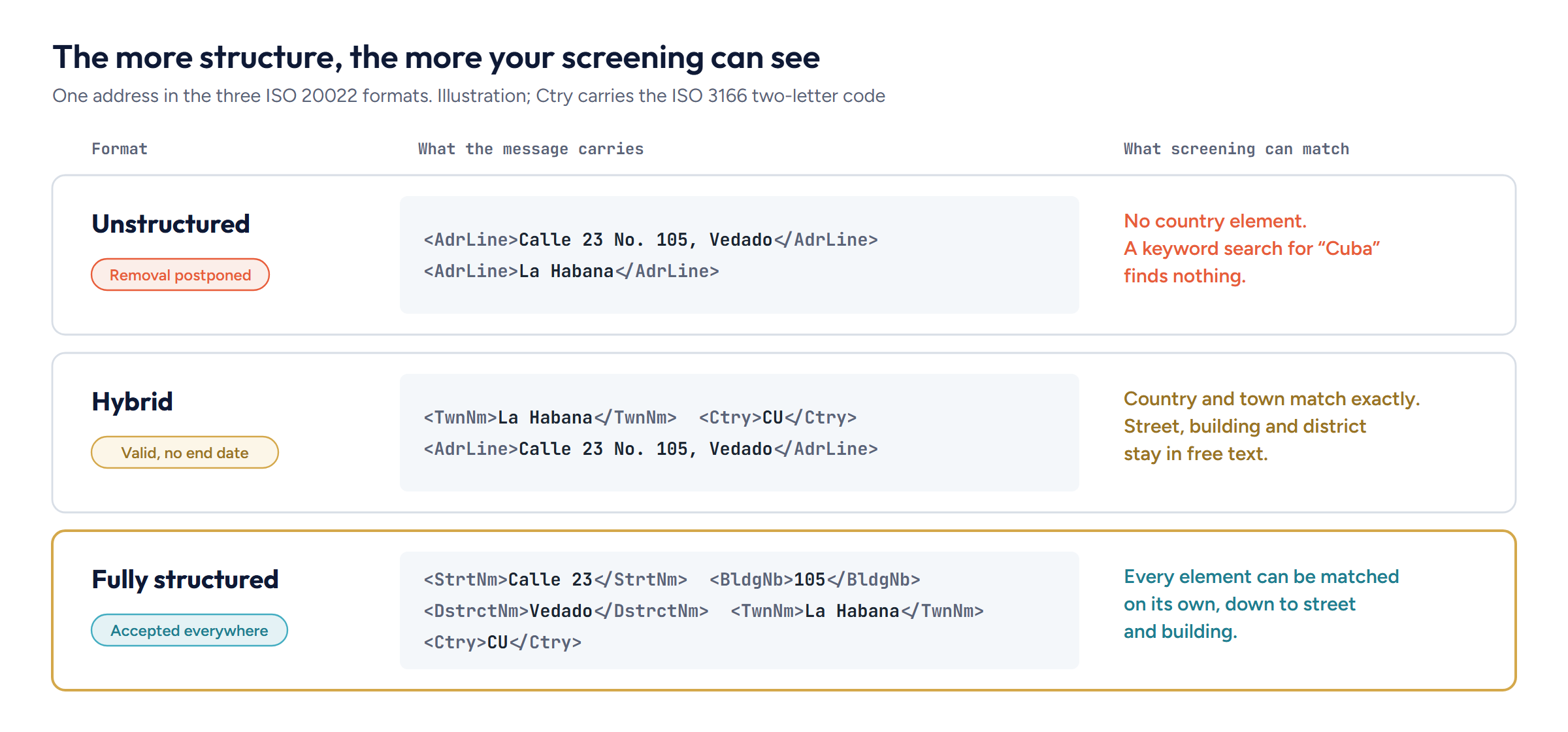
This is where "fully" earns its keep. Hybrid gives screening an exact country and town, a real improvement on free text. Fully structured adds the street, building, district, region and postcode — the elements that tell one of the 28 places called Paris from another, and that let a match work at the level of an address, not just a country.
Three things make ISO 20022 compliance work the natural place to start:
- The benefit lands inside the bank. That's why "it's for sanctions screening" failed as the pitch to corporates: they said screening is the bank's job.
- Much of the data is already in reach. Your customers' addresses are in KYC, and Swift's figures imply about half of all addresses already arrive in usable structured or hybrid form.
- R16 makes it urgent. The Fed's ISO 20022 lead called it more impactful than the address removal, and the CPMI is clear that the LEI it asks for adds to name and address; it doesn't replace them.
It is a growth story too. As the Deloitte speaker put it, precise controls make a bank the safer bank in a regulator's eyes — the one that can take on new markets and products with confidence.
What to do this quarter
What I'm watching
- 14 November: four corridors go live, and Swift measures how many banks have switched on voluntarily.
- HVPS+ guidance for infrastructures planning November 2027 releases, expected within weeks.
- Swift's new timeline: a firm date, which Deutsche Bank asked for at Sibos, or a roadmap with readiness criteria, which Swift, the Fed and HVPS+ argued for?
- The EPC's October decision on a new SEPA end date.
The test I'll hold all of it to is the Fed's: if unstructured addresses are still around in 2030, the industry has missed the mark.
The size of the job
51% and 53% aren't a reason to wait. They're the size of the job. The postponement bought time, and Sibos told us how to spend it: do it right, do it once, do it fully. Do that, and whenever the next date comes, you'll already be past it.
A disclosure, since you've read this far. ioNova builds address resolution software. Judge it, and any other tool or model, against the test the Sibos panels set out — the same output every time, a confidence score, a blank rather than a guess, a person in the loop — against PMPG's repair principles, and against the 25 criteria we have published, not against our word.
Before you go
Follow the dates as they move. Every issue of Resolved! carries the published positions of Swift, PMPG and the EPC, sourced and dated, with corrections published. No predictions.
Know your own 51% and 53% before Swift measures them. The exposure diagnostic applies the mapping procedure to your book — your corridors, your correspondents, every position sourced and dated — and our free readiness baseline is open to the first twelve institutions that request it. Request the exposure diagnostic through ionova.ai, or reply to any issue of the newsletter.
About the author. Parth Desai is Founder and Chairman of ioNova AI and has spent 30+ years in payments compliance and enterprise AI. He writes Resolved! — Address Intelligence Insights. Connect on LinkedIn · Subscribe to the newsletter
Key Takeaways
Frequently Asked Questions
Book Your Readiness Assessment
Run the map on your book — corridors, correspondents, and address readiness scored on live traffic. Walk away with a dated baseline and a first sprint, not another deck of dates.