
TL;DR
The November 2025 MT/MX coexistence deadline has passed. The one still ahead is different: ISO 20022 unstructured address removal deadline is 14 November 2026 and the structured-address standards take effect on 15 November 2026. Payments with unstructured addresses will be rejected at the network boundary — and ~65% of messages still carry them. Compliance is not one monolithic programme; it is a series of 2–4-week sprints, one per use case. Roughly fifteen weeks remain; three or four sprints fit — if the first starts now.
Score 10,000 of your messages, pick sprint one, and get the report in five working days. Complimentary through August for qualifying institutions.
I've watched the payments industry close out big migrations for more than three decades, and the ending is always the same scene: the programme shuts down, the congratulations go around, and everyone quietly assumes the hard part is behind them.
That's exactly where we are with ISO 20022. If you searched for "ISO 20022 deadline" recently, most of what you found was about November 2025 — the end of MT/MX coexistence, when the industry finished migrating its message formats. That project closed. The congratulations were deserved.
But when institutions tell me they're "done with ISO 20022," I have to give them an uncomfortable answer: the message format was the easy half.
The new ISO 20022 address requirements judge what's inside the message — and by SWIFT's own March 2026 figure, around 65% of payment messages still carry unstructured addresses. The last day for unstructured addresses is 14 November 2026 (the removal deadline). The structured-address rule takes effect on 15 November 2026 — from then, non-compliant payments aren't warned or delayed for repair. They are rejected at the network boundary.
Format-ready is not data-ready. That distinction is why ISO 20022 compliance is about to stop being a messaging project and become a data project.
And here is where I watch planning go wrong a second time. Institutions hear "data project" and reach for the eighteen-month-programme playbook — the same reflex I've seen in every technology cycle since the 1990s. From the readiness work my team runs, I can tell you the playbook that actually fits the time remaining is the opposite: small, repeatable, and fast — one use case at a time, each on a published 2–4-week arc.
This article is that plan, written for banks and PSPs on one side and corporate treasury on the other, because the mandate lands on both — in different places.
What the ISO 20022 Address Requirements Actually Say
Strip away the acronyms and the structured address requirements under SWIFT CBPR+ and the EPC's SEPA rulebook come down to three permitted shapes for a postal address in a payment message — reducing to two from the effective date. The address lives in the PstlAdr element, built on the PostalAddress24 model:
- Fully unstructured — everything crammed into free-text
AdrLinefields. This is what's being retired. From the effective date, it's the shape that gets rejected. - Hybrid — the compliance floor: Town (
TwnNm) and Country (Ctry) in their own structured fields, with at most two 70-character address lines carrying the remainder — and, per PMPG guidance, structured content must not be duplicated inside those address lines. - Fully structured — every component in its own field: street name, building number, postcode, town, country and the rest. Harder to reach, and where the real operational dividends live.
What "the rest" means is worth spelling out, because it is the reason "we already store an address" and "we can populate PstlAdr" are two different sentences. PostalAddress24 provides fourteen structured elements, grouped roughly four ways: street and building (street name, building number, building name, floor, room), locality (postcode, town name, town location, district), region and country (country sub-division, country code), plus post-box and department slots. A free-text address that a human reads effortlessly — "Frankfurterstr 87, 4th floor, 60311 Frankfurt" — maps onto six of those fields, and the mapping is exactly the work this mandate creates.
A worked example — the before/after most people ask me for, in both compliant shapes:
<PstlAdr>
  <AdrLine>FRANKFURTERSTR 87, 4TH FLOOR</AdrLine>
  <AdrLine>60311 FRANKFURT, GERMANY</AdrLine>
</PstlAdr><PstlAdr>
<StrtNm>Frankfurter Strasse</StrtNm>
<BldgNb>87</BldgNb>
<Flr>4</Flr>
<PstCd>60311</PstCd>
<TwnNm>Frankfurt am Main</TwnNm>
<Ctry>DE</Ctry>
</PstlAdr>Town and country structured; the remainder in ≤2 address lines; no duplication of the structured content in those lines (PMPG guidance):
One more shape of the work hides on the legacy side, and in my experience it is where the worst data always hides. Institutions still hold years of traffic and templates in MT103 free-text format — party addresses jammed into fields 50 and 59 with no structure at all. Converting that stock — MT103 to pacs.008 address conversion, the classic unstructured-to-structured address migration — is not a formatting exercise; the free text must be parsed, resolved and re-expressed into the structured party blocks. It is its own use case, and (as the sprint plan below shows) it is usually the second sprint an institution runs.
Two precision points most coverage gets wrong, and that materially shrink your scope:
- Agents are different. For agent (bank-to-bank) identification, BIC-only remains a valid option — you are not required to add name-and-address where a BIC already satisfies the rule. The weight of the mandate falls on party addresses: debtors, creditors and their equivalents.
- The rule reaches backwards in time. A payment submitted in October with a value date on or after 15 November 2026 is already in scope. In practice, compliance arrives weeks before the 14 November deadline.
The Arithmetic That Changes the Plan
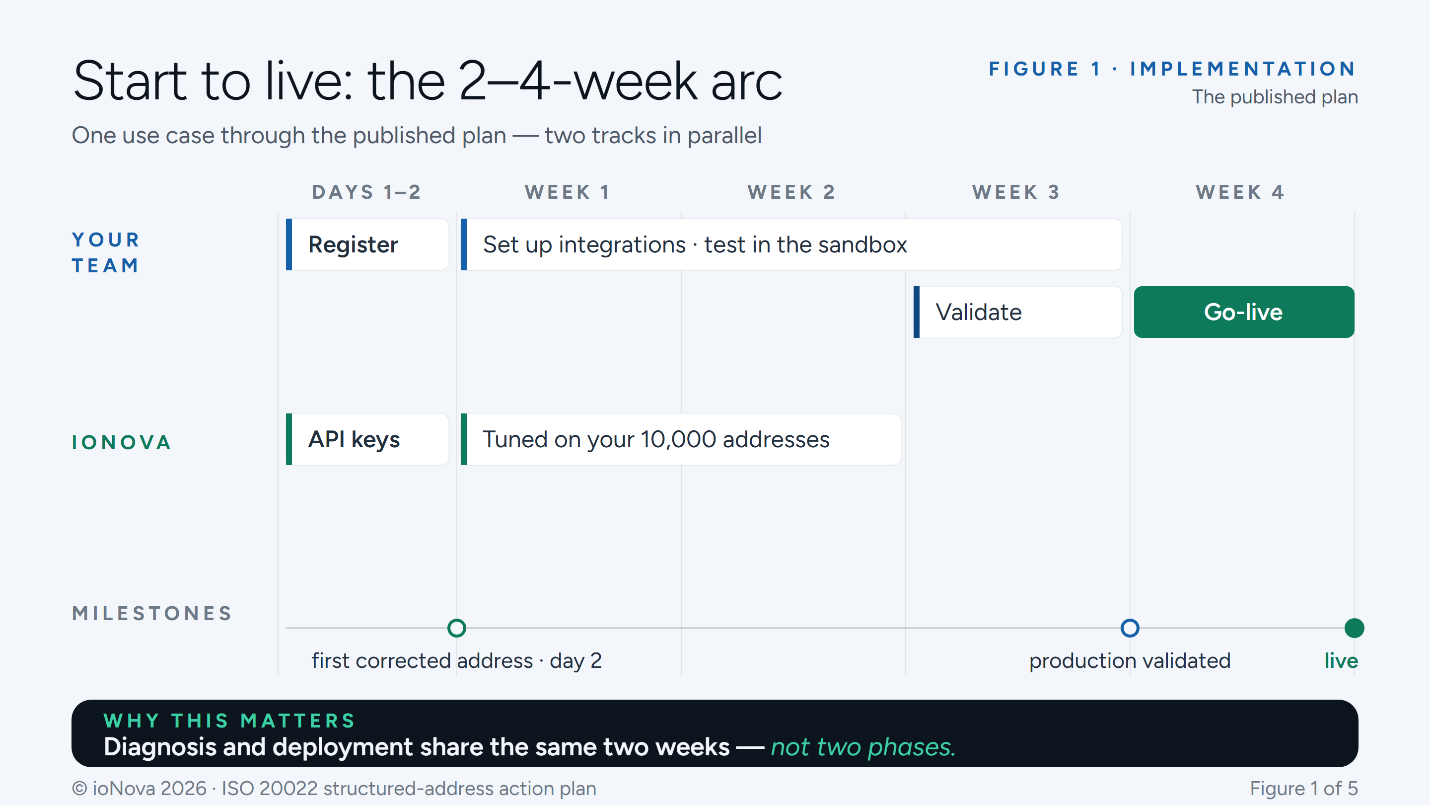
Count the time honestly. Roughly fifteen weeks separate an early-August start from the effective date. Fifteen weeks is uncomfortable for a monolithic remediation programme — and generous for what this transition actually requires, once you see it as it is: a set of separable use cases, each independently deployable on a 2–4-week arc.
The published implementation pattern looks like this:
- Days 1–2 — start. Register; API keys arrive the next business day; a sandbox is live on day 2 — and it is production-shaped: the full pipeline, the full reason-code catalogue, request and response schemas identical to production. Sandbox and UAT traffic is never metered; evaluation is free and unmetered, so no procurement is needed to start. When a channel is proven, going live is a key swap, not a code change.
- Weeks 1–3 — two tracks in parallel. Your team sets up integrations and channels, then tests in the sandbox — schemes, thresholds, output modes. In parallel, the engine is tuned on 10,000 representative addresses from your own traffic — the same sample that scores your readiness. Diagnosis and deployment are the same two weeks, not two phases.
- Week 3 — production validation across your channels and integrations.
- Weeks 3–4 — go-live, with parallel-run/shadow mode first if you want the evidence before the cutover switch.
Three consequences follow, and after thirty years of watching institutions plan transitions like this one, I'd call them the strategic heart of this article:
- You don't need one big decision — you need a first sprint. Pick the single worst use case (the next section shows how to find it) and put it through the arc. Everything after that is repetition with a tuned engine and a fluent team; second sprints routinely run faster than firsts.
- Three or four full sprints fit before the standards take effect. Sequential. More if you overlap them — and they overlap naturally, because a batch-remediation sprint (data at rest) and an in-flight-correction sprint (data in motion) don't compete for the same people.
- The build alternatives are no longer alternatives. An in-house address engine is an 18–36-month project; wrapping a generic postal-verification tool for payments runs 26–40 weeks — and postal validation is not payment validation in any case. At fifteen weeks, sidecar-deployed address resolution — running beside your payment infrastructure, no core replacement — is the honest shortlist. (If you are comparing approaches, the open evaluation framework is at ionova.ai/compare/.) And because pilot terms with shadow-mode deployment let the paperwork run in parallel with the pipes, by the time a contract is ready to sign, the system should already be proven on your own traffic.
You don't have to be finished with everything by 14 November. You have to have run the right sprints. Each one is 2–4 weeks, and the first can start this week.
Week Zero: Know Your Number, Then Pick Your First Sprint
The most common failure mode I see in this transition is starting with tooling instead of measurement. In readiness work we consistently see institutions self-assess a full maturity level above where their data sits.
A real baseline has three properties. It's scored on live traffic, not a questionnaire — a ten-thousand-message sample against the actual structure rules, flow by flow: pain.001 files from corporates, pacs.008/pacs.009 interbank traffic, and the legacy MT103-formatted stock where the worst data hides. It decomposes, because averages lie — in one recent assessment, a portfolio that looked healthy at headline level concentrated 47% of its entire unstructured exposure in a single intersection: one scheme, one message format, one corridor. The average said "fine"; the intersection said "your highest-volume Gulf corridor stops working in November." And it scores capability, not just data, across six dimensions: data at rest, data in motion, exceptions capacity, screening quality, auditability, and per-corridor posture.
That baseline does two jobs at once. It gives you your number — your maturity level, from L1 (free-text chaos) through L3 (hybrid-compliant, the floor the standards demand) to L4 (fully structured, where the dividends live). And it hands you your sprint order: rank exposure by intersection, counterparty and currency, and your first use case is sitting at the top of the table with a number attached — steepest compliance uplift per integration hour.
One more property makes week zero unusually cheap: it is not a detour. The sample that scores your readiness rides the same pipe production will use — the folder you drop your sample into is the folder you'll use in production — and the same ten thousand addresses tune the engine while your team wires channels. Diagnosis is day one of deployment, literally: same file, same folder, same engine.
The Sprint Plan, Use Case by Use Case
Here is the plan I believe most institutions should actually run — each row an independent 2–4-week sprint on the published arc, ordered the way the concentration table usually orders them. Level names which of the engine's two operating levels the sprint runs at (explained fully in the next section): message level for payments in flight, address level for data at rest. Time-to-first-value is when the use case starts producing corrected output; live is validated production.
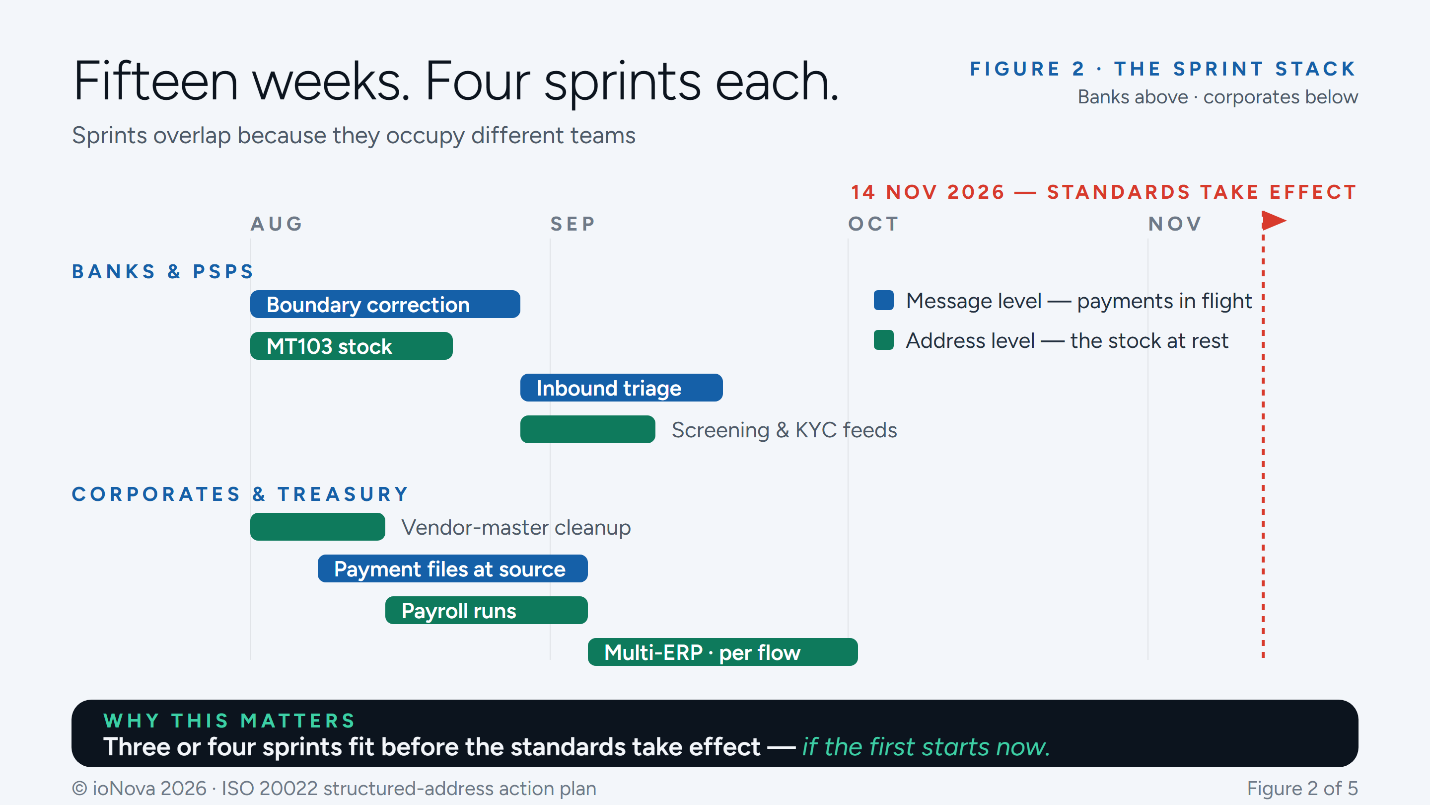
For banks and PSPs
| Sprint | Level · door | First value → live |
|---|---|---|
| 1 · Boundary correction, worst corridor first — pacs.008/009 fixed in-flight; sidecar, no core change | Message · API, or MQ/Kafka if your hub is queue-native | Day 2 sandbox → live wks 3–4 |
| 2 · MT103 stock remediation — legacy free text parsed into structured party blocks; 10,000 per batch | Address · SFTP or JDBC | Days → live wks 1–3 |
| 3 · Inbound correspondent triage — auto-repair what senders get wrong | Message · API / MQ | Wk 2 → live wks 2–3 |
| 4 · Screening & KYC feeds — screen on corrected data (~30% fewer false positives); batch-clean the KYC store | Address · JDBC or SFTP | After sprint 1 → +1–2 wks |
| (then) Client pre-validation service — a revenue flip, once sprints 1–2 are proven | Address · SFTP / Upload | → +2 wks |
For corporates and treasury
| Sprint | Level · door | First value → live |
|---|---|---|
| 1 · Vendor-master cleanup — correct the beneficiary masters; every future payment born clean | Address · Upload · SFTP · JDBC | Days → live wks 1–2 |
| 2 · Payment files at source — pain.001 fixed before the bank (and its scorecard) sees it | Message · API or SFTP | Wk 2 shadow → live wks 3–4 |
| 3 · Payroll & pension runs — pre-validated on the run schedule; one rejected batch is a missed payday | Address · SFTP | Wk 2 → live wks 2–3 |
| 4 · Multi-ERP / post-M&A — one sprint per ERP flow; each faster than the last | Per flow — JDBC, SFTP or API | Per flow → wks 3–4 each |
| (then) Treasury & intercompany — fewer RFIs on the payments where delay costs most | Message · API, inherited from sprint 2 | With sprint 2 → +1 wk |
A note for TMS and ERP platform vendors: you hold the highest-leverage seat in this transition — embed address resolution once, and every client on your platform inherits compliance as a feature. And where a platform already ships pre-built connectors into the major payment middleware, the embed is a configuration exercise, not a build.
The Two Operating Levels — and Why "Integration" Is Not a Schema Project
Look down the "Level · door" column and two patterns emerge that most compliance plans I review miss entirely. The first is about what travels to the engine; the second is about how it gets there. Together they decide whether the 2–4-week arc is realistic for your institution — which makes them buying criteria, whatever platform you evaluate.
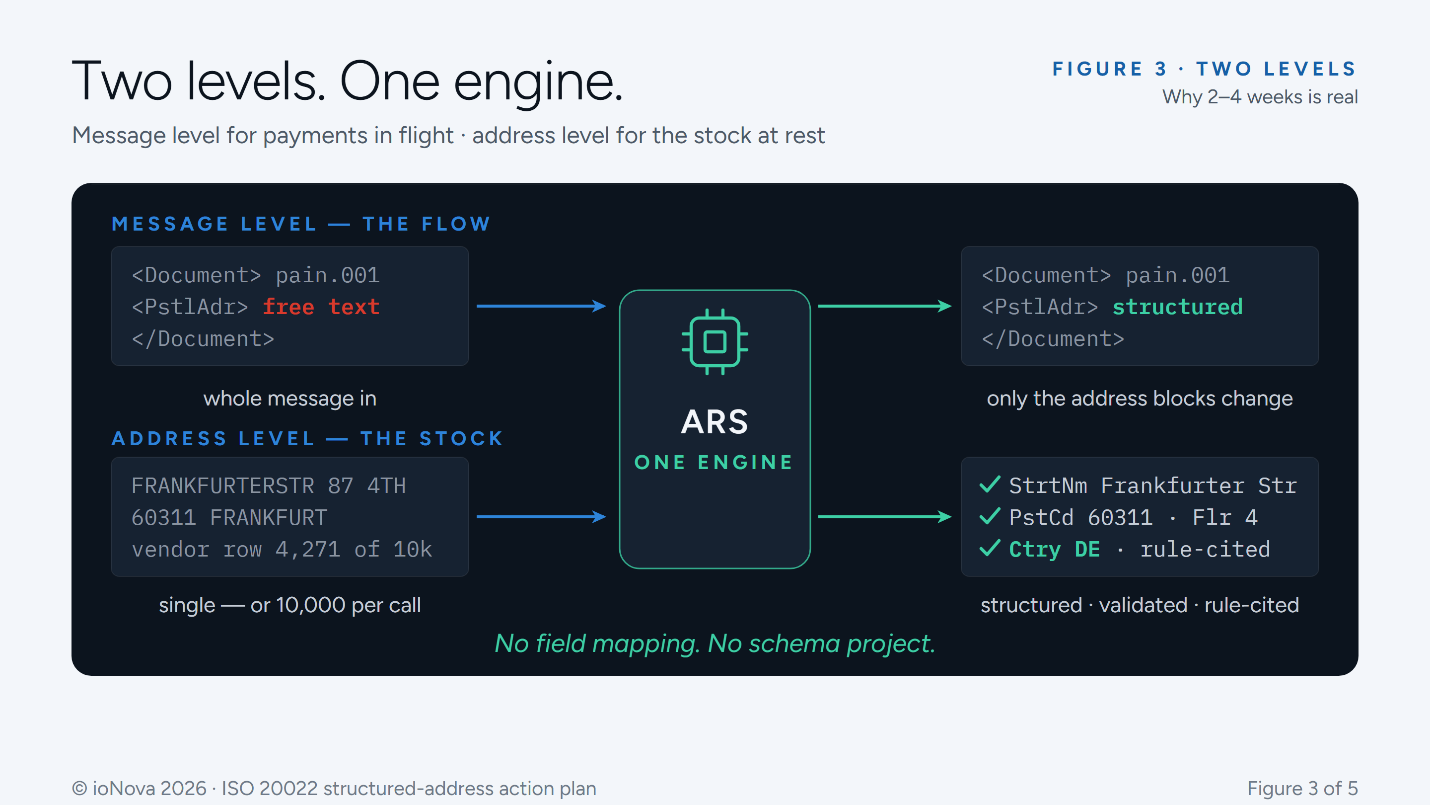
An address resolution engine built for payments works at two levels — and, apart from the browser studio (which exists for humans working one address at a time), every door opens at both. The level is a property of the work, not of the integration you happen to have.
Message level is for data in motion. You hand over a whole ISO 20022 payment message — a pain.001 from the payment factory, a pacs.008 or pacs.009 at the interbank boundary — and you get the same message back with every party address converted to structured form. The message stays intact; only the address blocks change. Read that sentence as an architect and its weight lands: there is no field mapping, no extraction, no reassembly, no schema project. Nobody writes a transformer that pulls addresses out of your message model and stitches corrected ones back in — the engine does the surgery in place. This is what makes "sidecar, no core change" a literal description rather than an architecture-diagram aspiration, and it is where the in-flight sprints (boundary correction, payment-file correction, inbound triage) run.
Address level is for data at rest. You send addresses themselves — one at a time, or in batches of up to 10,000 per call — and get back structured, validated, rule-cited results. This is the level for the stock: vendor masters, KYC address stores, standing instructions, the legacy MT103 backlog — and for point-of-entry validation and human casework on individual records.
The sprint mapping writes itself: data-in-motion sprints run at message level; stock sprints run at address level — same engine, same rules, same evidence. That identity is why a second sprint is faster than the first even when it uses a completely different door: the tuning your first sprint earned is already there when the second begins.
The Four Families of Doors — and Why the Fastest Integration Is the Rail You Already Run
The second pattern: the mandate is one rule, but the work it creates comes in four different shapes — and each shape has a natural family of doors into the engine.
| The rail | The doors | Levels | Built for — and who runs it |
|---|---|---|---|
| Real-time, in the payment path | API · IBM MQ · Kafka | Both | Payments in flight, corrected before screening and release — engineering, or almost nobody if your hub already speaks the queue |
| Batch, against the stock | SFTP · File Upload · Database (JDBC) | Both | The stock at rest: vendor masters, KYC stores, legacy files, payment runs — ops and data teams; drag-and-drop needs no IT ticket |
| Interactive, human judgment | Address Studio (browser, no code) | Address only | Single addresses and casework — ops analysts, KYC officers, evaluators |
| Agentic | MCP | Both | Your AI assistants calling the same engine — same rules, same audit trail |
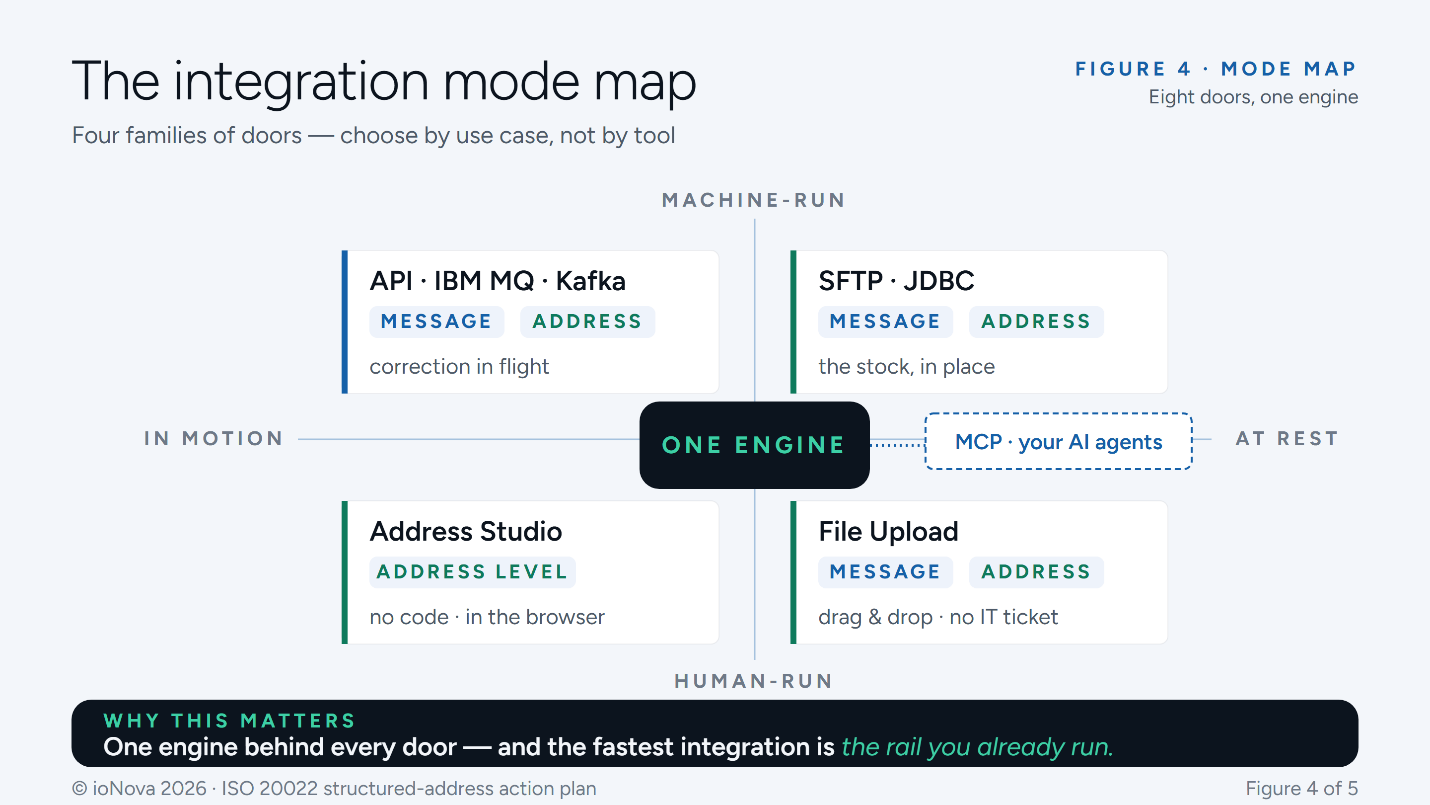
Here is why this table, and not the feature list, decides your November: the 2–4-week arc assumes integration is the short pole — and it only is when the platform meets your infrastructure where it already stands. A bank whose payment hub is queue-native drops message-level correction into the existing MQ or Kafka flow with no new plumbing. A treasury whose ops team moves files all day adds SFTP as one more folder in a process that already exists. A vendor master that lives in a database gets corrected over JDBC, in place. And when there's no one to integrate anything, File Upload and Address Studio need nobody at all. The fastest integration is the rail you already run — every door a vendor doesn't have is a workaround your team must build, and with fifteen weeks left, workaround-building is the schedule risk.
There is also a ladder hidden in that table, and it is the practical answer I give to "we can't start anything this quarter": upload a file today → schedule the folder next week → wire the queue or the API when engineering has a window. Each rung is production-real — same engine, same output, same evidence — and none of them invalidates the next. The institution that drags-and-drops its worst vendor master this afternoon has started its first sprint, whether or not anyone called it that.
The single-door counterfactual makes the stakes concrete. An API-only tool turns all four kinds of work into engineering projects queued behind one backlog; a batch-only tool leaves payments being born non-compliant while you clean yesterday's stock. Either way the sprint model itself collapses, because everything funnels through one team's capacity. Versatility is the mechanism that lets sprints run in parallel: the API/queue sprint occupies engineering, the SFTP and JDBC sprints occupy ops, uploads and Studio occupy the business — three tracks, three teams, nobody queuing behind anybody. That is what makes "three or four sprints before the effective date" realistic rather than brave.
One condition makes the versatility trustworthy rather than fragmentary: it must be one engine behind every door, at both levels. Same rules, same corrections, same rule-cited reason codes and audit trail whether an address arrived inside a pacs.008 on a queue, in a dropped file, through a database read, in an analyst's browser — or via an AI agent. A comprehensive platform isn't eight tools in a trench coat; it's one deterministic engine with eight ways in. That — given the shape of this mandate and the time remaining — is the need of the hour.
One discipline belongs to this section before any sprint starts: set the format policy before the sprint, not during it. Per scheme and flow: hybrid floor or fully structured target, PMPG non-duplication respected, BIC-only kept where it's valid for agents. One page, decided in week zero.
Score 10,000 of your messages, pick sprint one, and get the report in five working days. Complimentary through August for qualifying institutions.
Prove It as You Go — the Evidence a Sprint Leaves Behind
There is a version of this transition that passes November and fails March: addresses corrected, payments flowing, and no defensible account of why any given correction was made when an auditor, a regulator or a correspondent's compliance desk asks. I've sat in those March meetings, and they are avoidable. Address resolution for payments is a regulated-data activity, and the evidence layer is not an accessory — it is half the product.
Four properties make sprint output defensible:
- Every correction cites a rule. Each decision carries one of 30 rule-cited reason codes, drawn from the texts the rules actually live in — EPC 153-22, PMPG market practice, EU Regulation 2023/1113, CBPR+ usage guidelines — with per-field confidence recorded alongside. A correction is never "the model thought so."
- Every decision replays. Deterministic means bit-identical: re-run last quarter's decision today and get the same answer. That is the property an examiner actually tests, and it is the structural difference between a deterministic address resolution engine and a generative tool, which cannot make the same promise twice.
- The human ~2% is logged too. Roughly 98% of addresses resolve automatically; the remainder routes to a workflow — queues, confidence thresholds, maker-checker approval — with every human decision recorded to the same trail. Size that desk from the baseline, not from hope: the ~2% of a million-message month is still twenty thousand cases.
- The parallel run is measurable. Dashboards carry live STP rate, exception volumes and per-corridor posture while a sprint's shadow mode runs — so "proven" is a number on a screen, not a feeling in a steering meeting.
Run sprints this way and attestation stops being a phase at the end of a programme. It is an artifact each sprint leaves behind — and by the time the standards take effect, the evidence pack has been accumulating for months.
The Economics of Running the First Sprint Now
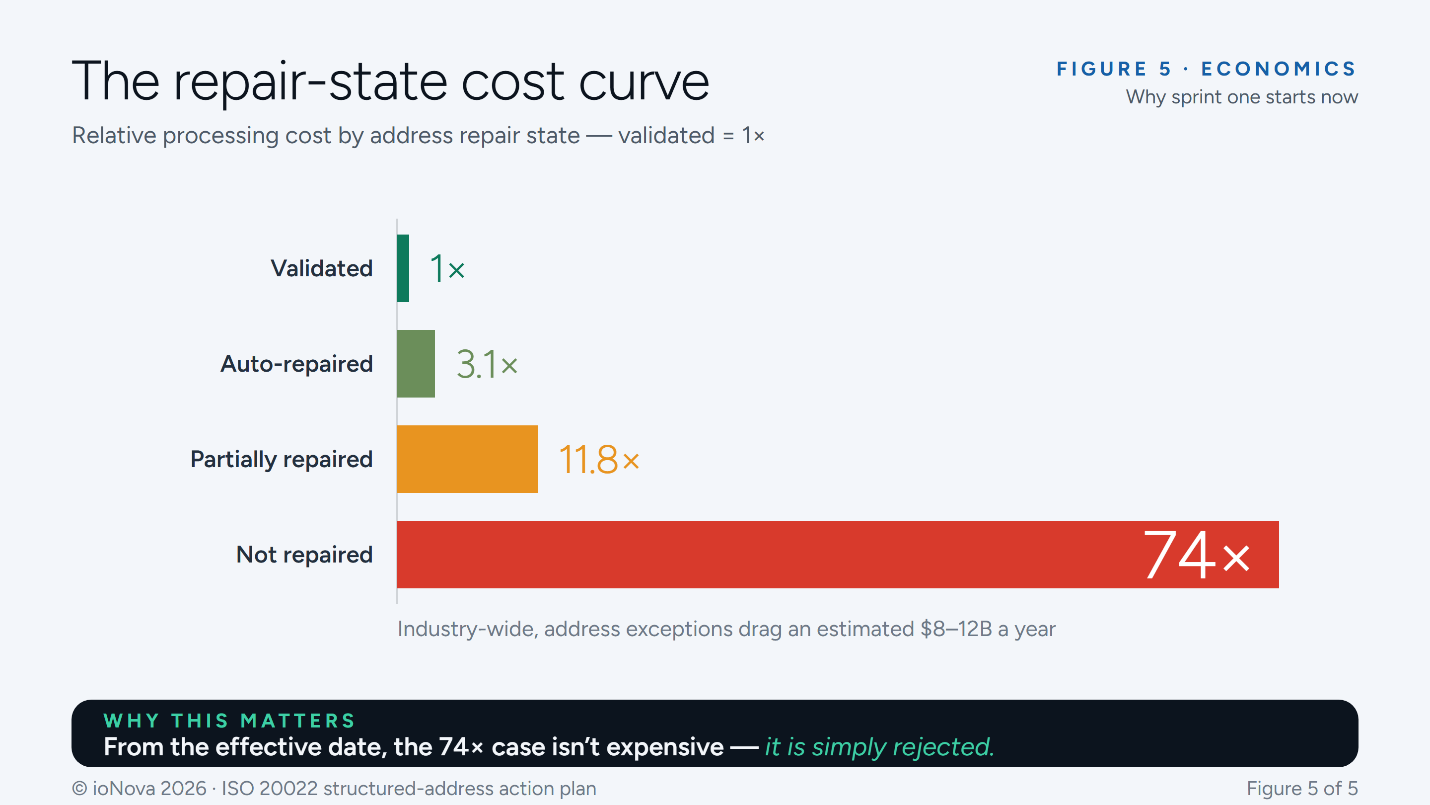
Industry-wide, address-related exception handling costs an estimated $8–12 billion a year, and the curve inside it is convex — if a validated address costs 1× to process, an auto-repaired one costs ~3×, a partially repaired one ~12×, and an unrepaired one 74×. From the effective date, the 74× case stops being an expensive payment and becomes a rejected one.
① Baseline your real traffic · ② Pick the worst intersection as sprint one · ③ Get its channel correcting in shadow mode.
How ioNova ARS Runs This Plan
Everything above is vendor-neutral; this section is not, and it's short.
ioNova ARS is a purpose-built address resolution service for exactly this problem: a deterministic engine — same input, same output, every decision traceable to a cited regulatory rule — covering 246 countries, preserving 50+ financial identifier types (the BIC embedded in an address line survives, ring-fenced, instead of being dropped), with AI assisting only on the ambiguous ~2% and a human in the loop. Because it's deterministic, there's a sentence worth writing plainly for every compliance officer: your data is never used to train anything.
The implementation plan pictured above is ioNova's published arc, and the platform maps to it directly. The STP Readiness Report does week zero: we run a 10,000-message sample of your outbound payment traffic through the production ARS engine on EU-resident infrastructure, hold a 90-minute working session with your team, and deliver your scored Readiness Report within five working days — scored across the six dimensions and decomposed into the concentration table that picks your first sprint. The same sample tunes the engine in parallel while your team sets up channels — and it rides the same pipe production will use, which is why diagnosis and deployment share the same two weeks.
On integration, the previous section already made the argument, so here is simply the fact: ARS opens every door in that table — API, IBM MQ, Kafka, SFTP, File Upload, Database (JDBC), MCP, and Address Studio — at both levels, whole message or individual address, with one deterministic engine behind all of them — so every address meets the same rules and leaves the same evidence (rule-cited reason codes, per-field confidence, bit-identical replay) whichever way it arrived. Your sprints integrate on the rails you already run. The Exceptions Workbench carries the ~2% that needs a human; dashboards make every sprint's parallel-run measurable.
The whole ladder, in one line: register today — API keys the next business day; first corrected address in minutes, in Address Studio or one API call; first channel live in 2–4 weeks; and with sprints sequenced, the full estate attested well before the standards take effect. A mid-tier European bank ran this arc from a 42% cross-border STP rate to 98.3% — sprint by sprint, corridor by corridor.
And through August, week zero costs nothing: the $5,000 STP Readiness Report is complimentary for qualifying institutions booked before 31 August — the 90-minute working session, the report in five working days, and your first sprint chosen before the month is out. If you'd rather start with five minutes than ninety, the self-serve scorecard gives you a provisional readiness score right now.
Parth Desai has spent more than three decades building AI systems for payments and financial services, and leads ioNova's work on ISO 20022 address resolution. He writes regularly on payments data, compliance and AI adoption in financial services.
Key Takeaways
Frequently Asked Questions
Book Your Readiness Assessment
The $5,000 STP Readiness Report is complimentary for qualifying institutions booked before 31 August — 90-minute working session, report in five working days, first sprint chosen. Prefer five minutes? Get your provisional score now.