I sat through a panel at a SWIFT conference last year where a payments executive asked the room: "So, should we implement structured or hybrid addresses?" Every head nodded. It seemed like a perfectly reasonable question. Three panelists offered three different answers. The audience left more confused than when they arrived.
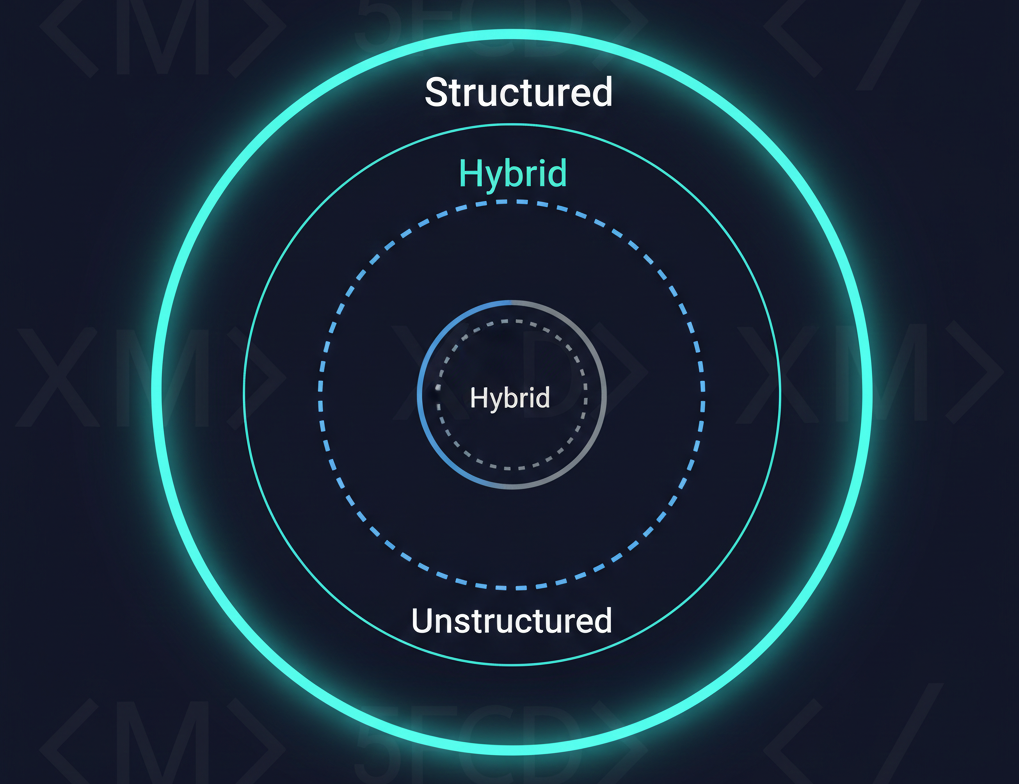
Here's the thing: that question has a structural flaw. It treats structured and hybrid addresses as parallel options you evaluate against each other — like choosing between two vendors or two integration patterns. They're not parallel. They exist in a hierarchical relationship. Hybrid is a subset of structured. Choosing structured automatically satisfies hybrid requirements. The effort is identical. The outcomes are not.
The real question isn't "which should we implement?" It's "why would we accept less when the effort is the same?"
If you're navigating the ISO 20022 address requirements ahead of the November 2026 deadline, this distinction isn't academic. It determines whether you'll need one migration project or two.

The Industry Is Asking the Wrong Question
The "structured vs. hybrid" framing has become so pervasive that even AI assistants present a comparison table with trade-offs hybrid described as "more flexible," structured as "rigid." Consultants frame the migration as a linear progression: unstructured → hybrid → structured, implying two sequential projects. Some vendors position hybrid as "good enough" because their technology can't fully parse addresses into discrete components across 247 countries and 50+ writing systems.
All of this creates the impression that hybrid is a legitimate destination. It's not. It's a waypoint that the three regulatory bodies driving this mandate the European Payments Council, SWIFT CBPR+, and CPMI/BIS all explicitly identify as the minimum fallback, not the target state. (For a detailed breakdown of what each body actually requires, see What Regulators Actually Require.
To understand why, you need to see what these formats actually look like inside the ISO 20022 schema.
Structured vs. Hybrid: The XML Reality
Both structured and hybrid addresses live inside the same ISO 20022 <PstlAdr> element. They use the same schema. The difference is which sub-elements are populated and which are left as free text. (For a complete reference of every field in the postal address schema, see ISO 20022 Address Fields Explained)
Fully Structured Address
<PstlAdr>
  <StrtNm>Bahnhofstrasse</StrtNm>
  <BldgNb>42</BldgNb>
  <PstCd>8001</PstCd>
  <TwnNm>Zürich</TwnNm>
  <Ctry>CH</Ctry>
</PstlAdr>
Hybrid Address (Same Schema, Fewer Fields)
<PstlAdr>
  <AdrLine>Bahnhofstrasse 42, 8001</AdrLine>
  <TwnNm>Zürich</TwnNm>
  <Ctry>CH</Ctry>
</PstlAdr>
Look at these two blocks. They both use <PstlAdr>. They both produce valid ISO 20022 messages. The structured version populates discrete, semantically tagged elements street name, building number, postal code, town, country each in its own field. The hybrid version collapses the street, building number, and postal code into a free-text <AdrLine> and only tags the town and country separately.
This is why hybrid is a subset: it uses the same container with fewer fields populated. Every hybrid address is structurally valid. Not every structured address is hybrid. The diagram below makes this relationship concrete.
Concentric, not parallel. Hybrid is a subset of structured — not an alternative.
The practical implication is significant: if your system already touches the <PstlAdr> schema to produce hybrid output, the incremental work to populate the remaining discrete fields is marginal. The schema mapping is done. The integration is built. What's missing is the parsing depth, the ability to break "Bahnhofstrasse 42, 8001" into its component parts and place each in the correct element.
Identical Effort, Vastly Different Outcomes
Both structured and hybrid require the same core implementation work: connecting to the PostalAddress schema, mapping source data fields, integrating with payment message flows, and testing across corridors. The implementation effort is the same because both formats live in the same XML container. The difference is what happens downstream.
The hybrid-only path produces a valid ISO 20022 message, but it leaves the hardest part unsolved. Free-text <AdrLine> content still requires interpretation at the receiving end. Correspondent banks and intermediaries can't reliably parse "Bahnhofstrasse 42, 8001" from a free-text line, which means the same ambiguity that causes exceptions today persists. Structured addressing eliminates this entirely by placing each component where systems can read it deterministically.
For sanctions screening, the difference is even starker. Unstructured and hybrid data forces screening engines into string-level matching which is how "Cuba Street, Wellington" triggers Cuba sanctions alerts. Structured data enables field-level matching: the country code is screened as a country, the city name as a city. Context replaces coincidence.
The cost of structured isn't higher than hybrid. The cost of hybrid is not getting structured.
How "Structured vs. Hybrid" Became the Wrong Debate
There are understandable reasons this framing took hold. SWIFT's own documentation describes both formats without always clarifying the hierarchical relationship, creating the impression of parallel tracks. During the early phases of the CBPR+ migration, consultants reasonably advised institutions to "start with hybrid, graduate to structured" which sounds pragmatic but is actually a two-project plan disguised as caution.
Vendor dynamics reinforced the framing. Some address validation providers can deliver hybrid output tagging the town and country from a free-text block — but lack the multi-country parsing capability to populate all discrete elements across 247 countries and 50+ scripts. For those vendors, positioning hybrid as "compliant" is technically accurate. It's also strategically misleading.
But the standard itself is clear. The EPC mandates structured elements for SEPA. SWIFT CBPR+ designates structured as best practice with hybrid as the minimum fallback. CPMI/BIS, through the G20 cross-border payments roadmap, identifies structured data as foundational. Three independent bodies. One destination. Not hybrid.
What This Means for Your Migration
If you haven't started your ISO 20022 address migration, target structured from day one. The implementation timeline typically 10–16 weeks with no legacy system changes required is the same whether you target hybrid or structured. There's no cost advantage to aiming lower.
If you're already on a hybrid path, you're closer to structured than you think. The schema integration is done. The data mapping exists. What's missing is the parsing and enrichment layer that breaks free-text address components into discrete, validated fields — the step where purpose-built address intelligence outperforms generic validation.
If you're evaluating vendors, ask one question: "Does your solution populate all discrete PostalAddress elements StrtNm, BldgNb, PstCd, TwnNm, Ctry or does it fall back to AdrLine for unresolved components?" The answer tells you whether you're buying structured or hybrid with structured branding.
The November 2026 enforcement deadline is nine months away. That's enough time for one well-executed structured implementation. It's not enough time for a hybrid project followed by a structured upgrade. Choose once. Choose right.
Key Takeaways
- 1 Hybrid is a subset of structured — not a parallel option. Every hybrid address is a valid structured address with fewer populated fields.
- 2 Implementation effort is identical — both use the same PostalAddress schema. The delta is parsing depth, not system architecture.
- 3 Outcomes are vastly different — structured delivers 98%+ STP rates; hybrid-only delivers 5–15% improvement over baseline.
- 4 Three regulators converge — the EPC, SWIFT CBPR+, and CPMI/BIS all designate structured as the target state, not hybrid.
- 5 The real question isn't "which?" — it's "why would you accept less when the effort is the same?"
Frequently Asked Questions
Parth Desai is Founder and Chairman of ioNova AI. With over 30 years at the intersection of artificial intelligence and financial services, he has led the design and deployment of AI-driven systems across 100+ financial institutions in 55+ countries. A graduate of IIT Bombay and Georgia Tech (AI), and a research scientist under AI pioneer Roger Schank at Yale, Parth is a recognised voice on payments data quality and regulatory technology. About ioNova →