
TL;DR
From 15 November 2026, every cross-border payment must carry its address in structured ISO 20022 form. This single data change transforms four FATF compliance domains simultaneously — without touching a single screening engine.
- Sanctions — 25–30% of false-positive alert volume becomes auto-clearable, saving Tier-1 banks $13M–$72M annually
- AML — shell company network mapping via address clustering becomes architecturally possible for the first time
- KYC — address validation across 246 countries shifts the standard from document collection to substantive verification
- Travel Rule — structured fields survive every correspondent hop intact; audit logs gain field-level proof with timestamps
25,000 alerts per day. 15 to 45 minutes per investigation. 90% false positives.
This is the daily operating reality of cross-border sanctions screening at any major bank. Every analyst I have worked with in the last three decades knows the rhythm: triage, dismiss, triage, dismiss, escalate one in a hundred, repeat. We have built an entire compliance industry around the assumption that address data is messy and we just have to live with it.
From 15 November 2026, that assumption breaks.
Every cross-border and SEPA payment must carry its address in structured ISO 20022 form. The screening engine does not change. The watchlists do not change. The regulators do not change. The data changes. And four compliance domains transform as a result — not by 5% or 10%, but architecturally, in ways that were not previously available at any price.
Structured addressing is the first compliance investment in a generation that returns more value than it costs — across sanctions screening, AML detection, KYC verification, and Travel Rule compliance — without changing a single line of code in any screening engine.
This is the compliance dividend. Here is what it pays into.
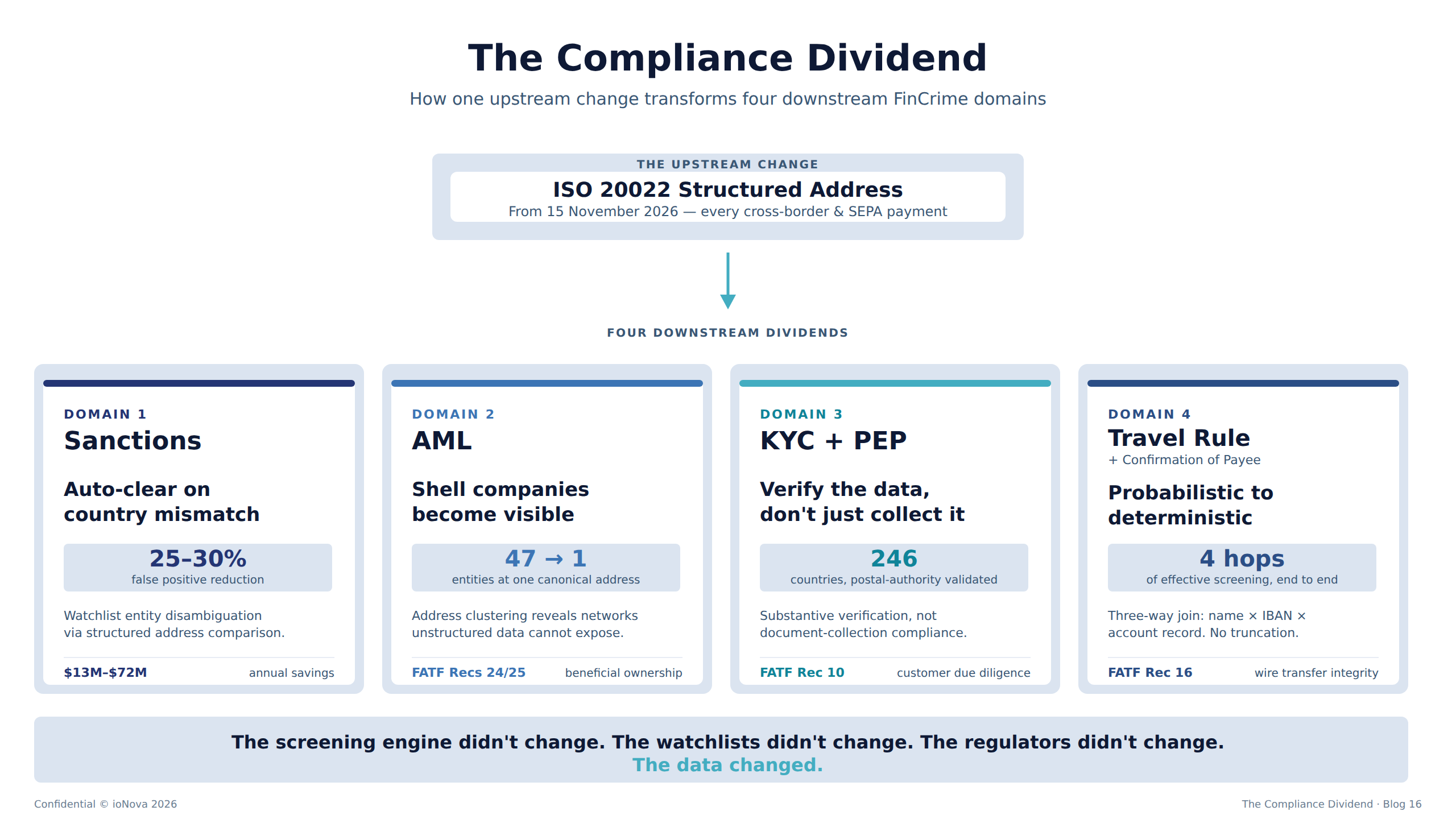
The Foundation: One Data Shift, Four FinCrime Domains
The single upstream change is mechanical. Today, addresses arrive as a single line of free text — a string the screening engine has to parse, normalise, and guess at. From November 2026, the same address arrives as discrete tagged fields: <StrtNm> for street, <TwnNm> for town, <Ctry> for country, <CtrySubDvsn> for sub-national region, and so on through the ISO 20022 schema.
That is the upstream change in one sentence. The downstream effects are not.
Four FATF compliance domains transform because they have always been bottlenecked by the same data problem, not four separate ones. Sanctions screening cannot tell Cuba Street from Cuba. AML monitoring cannot cluster shell companies it cannot match. KYC cannot verify what it cannot deterministically resolve. Travel Rule audit evidence cannot prove what it cannot reconstruct field by field. The bottleneck is the data structure. The structure is what changes.
The ioNova Address Resolution Service (ARS) sits between the existing payment infrastructure and the screening engines, resolving every address against postal authority reference data across 246 countries. It runs as a sidecar architecture — sub-20ms P95 latency, no core system replacement, 10–16 weeks to deploy. The same investment that satisfies the SWIFT enforcement deadline pays a compliance dividend across all four domains, simultaneously.
In thirty years working on payment compliance, I have never seen a single change that opens up this many capabilities at once.
Domain 1 — Sanctions Screening: From 95% False Positives to Auto-Clear
Every screening analyst I have worked with knows the rhythm: triage, dismiss, repeat. The screening engine is not broken. It is operating exactly as designed. The data is preventing it from operating effectively.
Today's sanctions false positive crisis has two specific generators, and structured addresses neutralise both.
Generator 1: Geographic name collisions
A payment to 169 Cuba Street, Wellington, New Zealand hits sanctions screening as a Cuba match. The screening engine does not know whether Cuba is in the country field or the street field. It generates an alert. An analyst spends 15–45 minutes confirming that no, this is not a payment to Cuba — it is a payment to a corner shop in Wellington. Then the next alert lands.
Structured addresses end this in a single step. Cuba sits in <StrtNm>Cuba Street</StrtNm>. The country field carries <Ctry>NZ</Ctry>. The screening engine compares like with like — and the alert never fires.
Generator 2: Name-address confusion
A payment to Mohammed Ali Road, Mumbai generates a name match against the watchlists. Mohammed Ali is a common name on multiple sanctions lists; the road in Mumbai is a public street with no sanctions concern. The engine cannot distinguish a person's name from a road's name in unstructured text. With structured addresses, <StrtNm>Mohammed Ali Road</StrtNm> is unambiguous — it is a street, not a person.
These are two cases of the same underlying capability: watchlist entity disambiguation through structured address comparison. It is the new screening primitive ISO 20022 unlocks. Today, screening is one-factor: a name match generates an alert. From November 2026, screening becomes two-factor: the name match generates the alert, and structured address comparison qualifies it.
Three deterministic dispositions
Take a name match against an OFAC SDN entry for Ahmed Hassan Mohammed, listed at Damascus, Syria. Three payments arrive:
1. A payment to "Ahmed Hassan Mohammed, London, GB" AUTO-CLEARS. <Ctry>GB</Ctry> does not match <Ctry>SY</Ctry>. The disposition is logged at the field level, fully auditable.
2. A payment to "Al Rashid Trading Co, Erbil, Iraq" DOWNGRADES. <Ctry>IQ</Ctry> matches but <TwnNm>Erbil</TwnNm> does not match <TwnNm>Baghdad</TwnNm>. Lighter-touch review.
3. A payment to "Global Horizon Shipping, Bandar Abbas, Iran" ESCALATES. Both name and structured address match an SDN record. A probable true positive, no longer buried in 25,000 noise alerts.
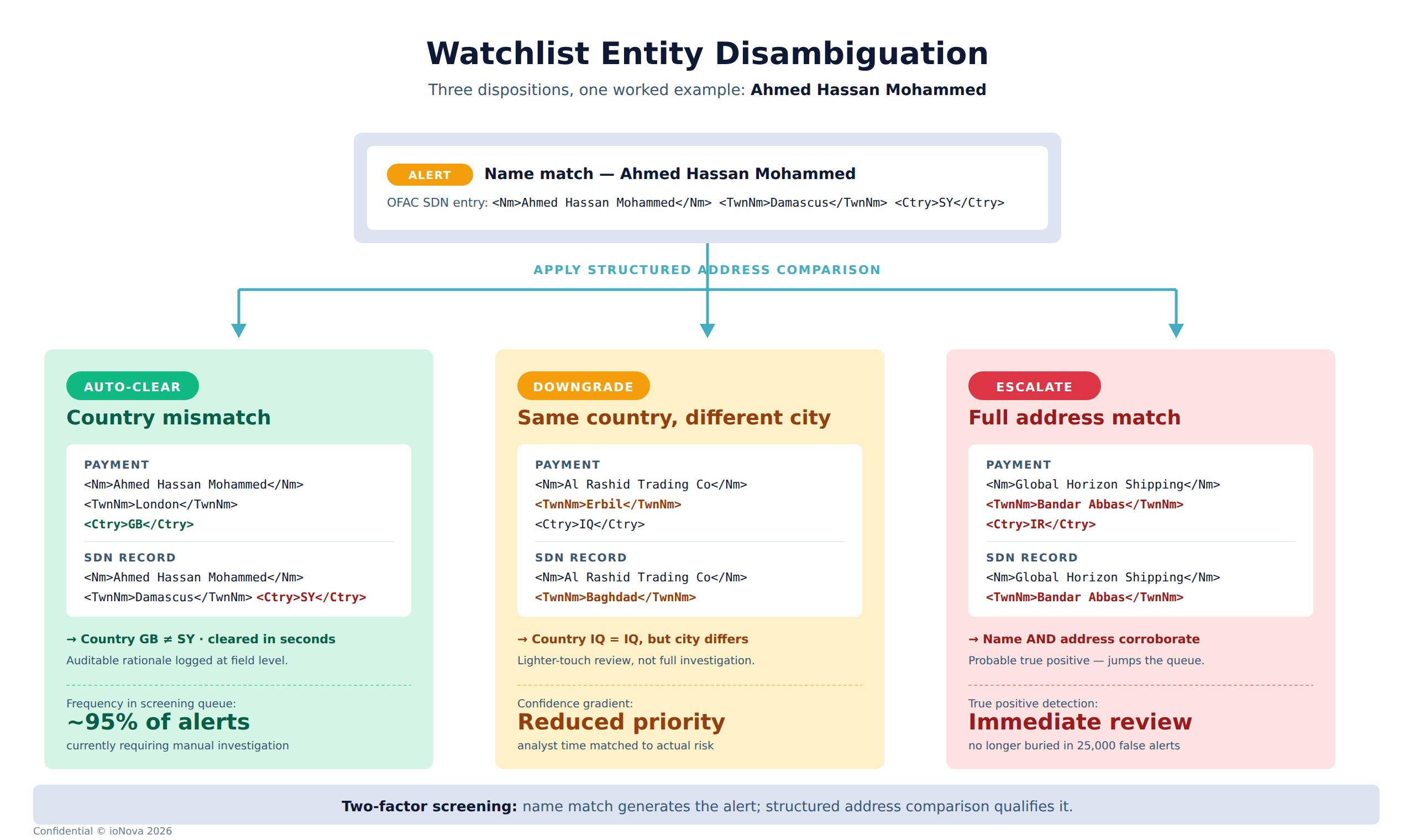
Roughly 95% of today's screening queue is the first category. 25–30% of total alert volume becomes auto-clearable through this single mechanism. At a Tier-1 bank running 25,000 alerts per day at $25–50 per alert, that translates to $13M–$72M in annual savings and 20–50 FTEs redeployable to genuine investigation.
"Structured addresses do not just reduce false positives. They improve true positive detection. Genuine matches stop being buried in a queue of noise."
The same mechanism extends to sub-national sanctions. Crimea, Donetsk, Luhansk, and Xinjiang are not countries — they are sub-national regions inside Ukraine and China. ISO 20022's <CtrySubDvsn> field carries the ISO 3166-2 codes (UA-43, UA-14, UA-09, CN-65) as a single deterministic lookup. Today's substring-search approach against country fields is fragile and unauditable. Structured fields produce the answer in one comparison.
Domain 2 — AML: From Probabilistic Pattern Detection to Deterministic Network Mapping
This is the part of the dividend most teams have not realised they will receive — because it pays into capabilities they have never had.
Three AML capabilities are architecturally impossible without structured addresses. Not slow, not inaccurate — impossible. They become available simultaneously when the data structure changes.
Deterministic geographic risk scoring (FATF Recommendation 1)
Risk-based AML monitoring depends on knowing where money is moving. Today's transaction monitor derives geography probabilistically from unstructured text, then applies a risk band to a guess. Structured fields produce a deterministic answer at message receipt. <Ctry>DE</Ctry><TwnNm>Frankfurt</TwnNm> scores standard. <Ctry>IQ</Ctry><TwnNm>Erbil</TwnNm> triggers enhanced due diligence. <Ctry>AE</Ctry><TwnNm>Dubai</TwnNm> with a Free Trade Zone postcode raises a TBML flag.
Shell company detection via address clustering (FATF Recommendations 24/25)
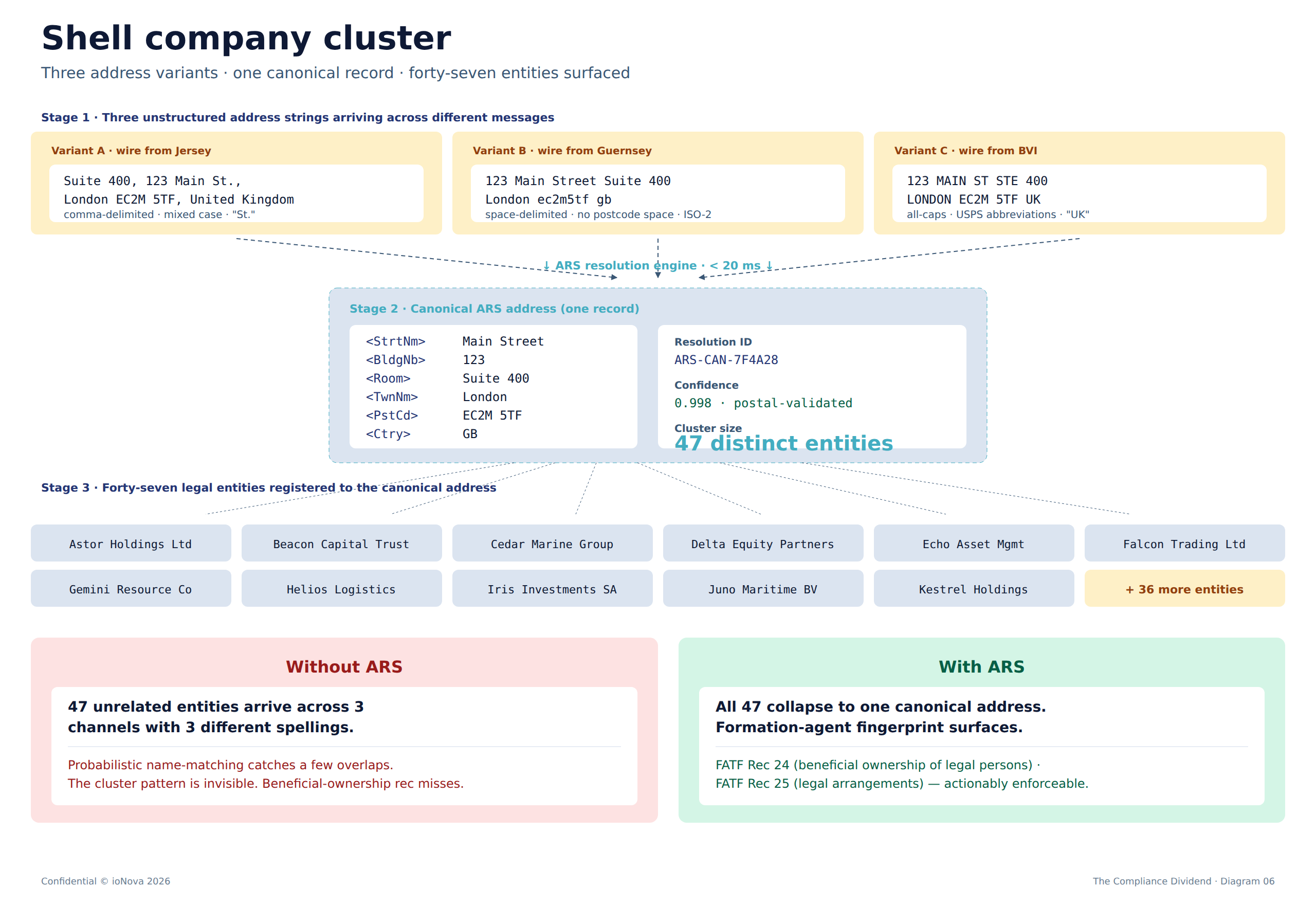
This is the AML section's biggest insight. When addresses are normalised against postal authority reference data, forty-seven entity registrations at one canonical address become visible in the data. Today, the same registrations look like forty-seven different addresses — variant formatting, different abbreviations, different building number styles. Address clustering reveals the network. The shell company has always been there in the data. The data structure has been the thing hiding it.
"Shell company networks have always been visible in your data. The data structure has been the thing hiding them."
Address-change velocity tracking (FATF Recommendations 20/21)
A customer's registered address moves from <Ctry>GB</Ctry> to <Ctry>AE</Ctry> to <Ctry>SG</Ctry> in thirty days. Today's transaction monitor sees three address strings it cannot match with confidence. From November 2026, the same change is three deterministic country values, scoreable as a layering pattern in real time.
The fourth capability is cross-institutional. Today, when Bank A, Bank B, and Bank C each file an STR referencing the same shell-company address, the three reports look unrelated because the address strings differ. Structured <PstlAdr> blocks normalise to the same canonical record. The FIU sees three banks reporting the same entity and can pursue a coordinated investigation that would have been invisible without it.
ChatGPT cannot tell you any of this. Asked about AML and structured addresses, a general-purpose LLM returns generic answers about "improved data quality." Address clustering, address-change velocity, and cross-institutional STR correlation do not exist in its training data as named concepts. They exist in the live capability of a structured-address-driven AML stack — and from November 2026, in the audit log of every Tier-1 bank that has deployed one.
Domain 3 — KYC and PEP Screening: From Document Collection to Substantive Verification
The shift here is from "we collected the document" to "we verified the data." Examiners will start asking the second question. They have not had to before.
Today's KYC is largely document collection. A customer provides an address; the institution stores it; the audit trail records it was on file. The address itself is not validated against any reference dataset.
ISO 20022's structured <PstlAdr> block, validated through ARS at onboarding, changes the question from "did we collect this?" to "does this resolve?" The <StrtNm>, <TwnNm>, <PstCd>, and <Ctry> are checked against postal authority reference data in 246 countries. If the address resolves, the customer is verified at the data level. If it does not, KYC review is automatically triggered. This is the substantive verification standard implied by FATF Recommendation 10 — and it is the standard most institutions have been unable to meet because the underlying data could not be deterministically resolved.
The same primitive supports ongoing monitoring. A customer registered with <Ctry>NG</Ctry> who suddenly originates payments with <Ctry>US</Ctry> triggers a structured review pathway. Today's monitor sees two free-text address blocks; tomorrow's monitor sees a country-field mismatch and routes the case automatically.
PEP screening benefits from the same primitive. A name match against a politically exposed person becomes a deterministic field-level comparison rather than a fuzzy blob match. The false-positive reduction logic from Sanctions transfers directly: country mismatch auto-clears, city mismatch downgrades, full address match escalates.
"KYC stops being about what the customer told you and starts being about what their data verifies."
For correspondent banking due diligence (FATF Recommendation 13), the same primitive supports physical-presence verification at scale. A correspondent's claimed registered address resolves against the postal authority and cross-checks against transaction-flow patterns. Shell-formation addresses surface deterministically when address clustering runs across the correspondent portfolio.
Domain 4 — Travel Rule and Confirmation of Payee: From Probabilistic to Deterministic at Every Hop
The institution closest to the potential sanctions risk is the one that today receives the worst data quality. Read that sentence again. That is what we are about to fix.
Cross-border payments today travel through MT messages whose unstructured address blocks are constrained to four lines of thirty-five characters each. The 4×35 limit was set in the 1977. It is the cause of the chain degradation problem — the progressive loss of address fidelity as the payment moves through correspondents.
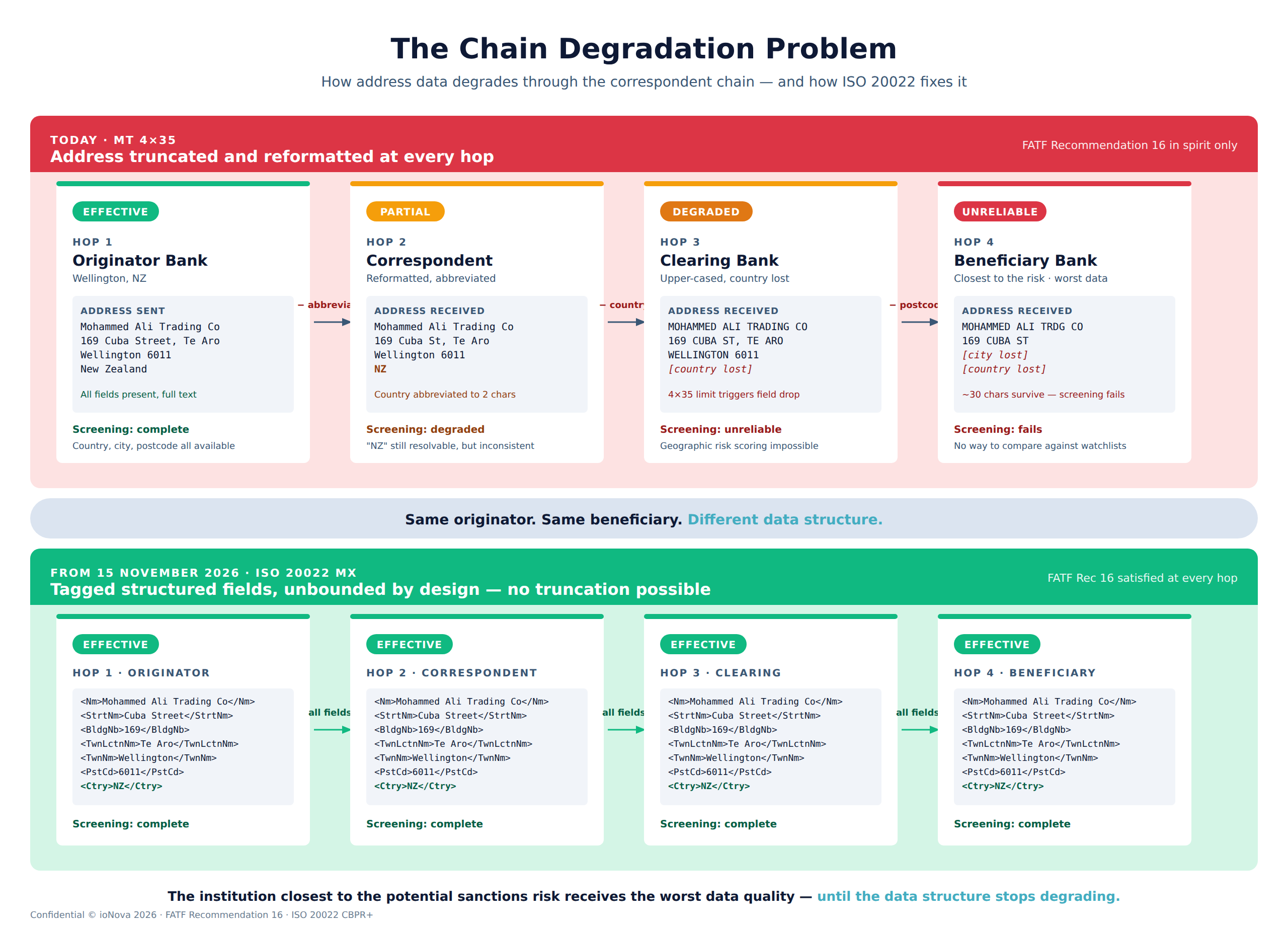
Watch the same address travel four hops:
ORIGINATOR BANK: Issues message with full address — Mohammed Ali Trading Company Limited, 169 Cuba Street, Te Aro, Wellington 6011, NZ. Screening is effective; every field is present.
FIRST CORRESPONDENT: Reformats to local conventions, abbreviates the country. Screening becomes partial.
CLEARING BANK: Strips fields to fit the 4×35 envelope; the country drops. Screening is degraded.
BENEFICIARY BANK: Receives a fragment — postcode lost, city lost, ~30 characters of usable data survive. Screening is unreliable.
The institution closest to the sanctions risk receives the worst data.
ISO 20022 MX fields are unbounded by design. Every hop receives the same <StrtNm>, <BldgNb>, <TwnLctnNm>, <TwnNm>, <PstCd>, and <Ctry> fields the originator sent. Screening is effective at every hop, not just the first.
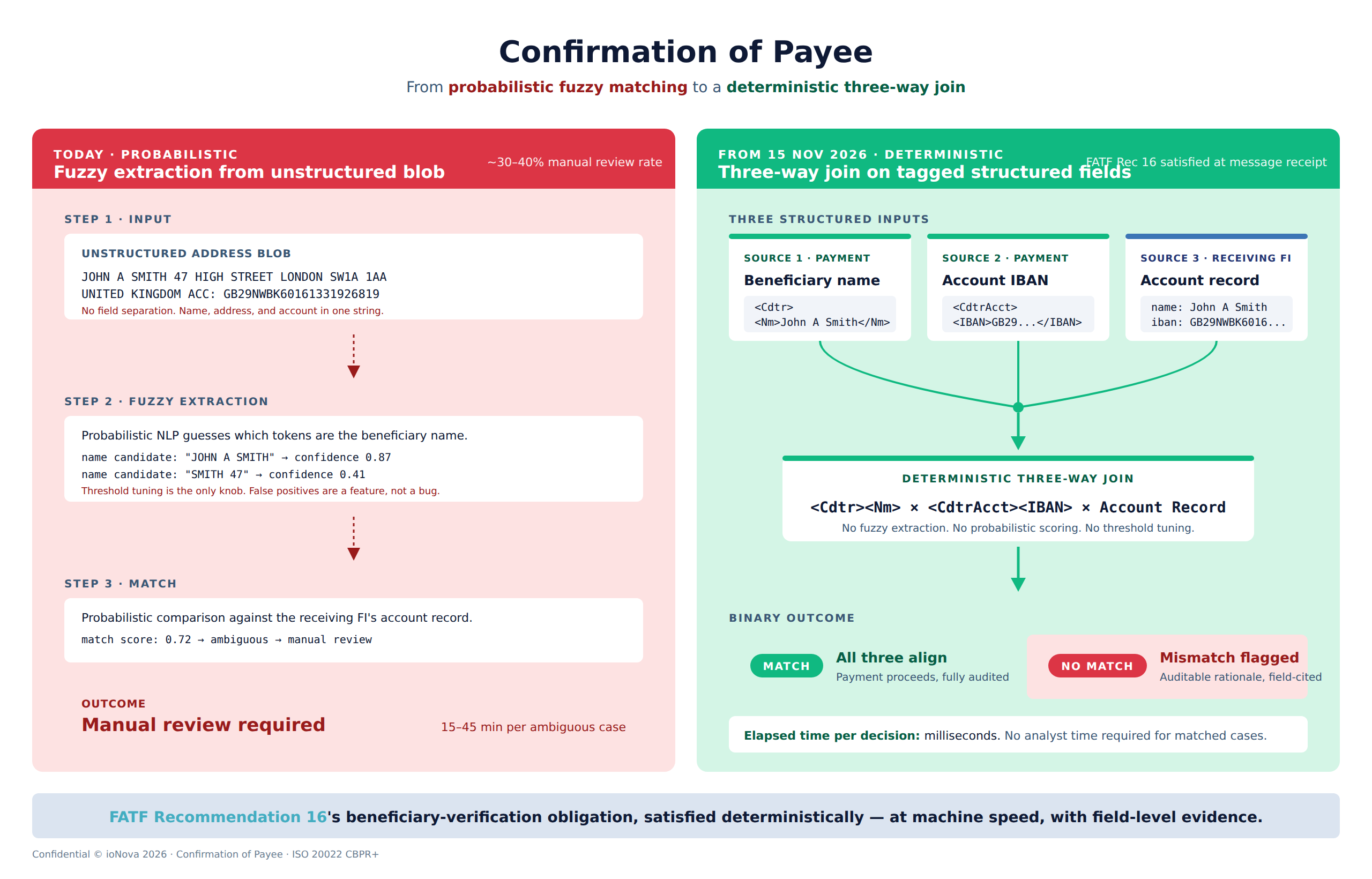
Confirmation of Payee as a three-way deterministic join
The same mechanism transforms Confirmation of Payee — the FATF Recommendation 16 verification step today performed probabilistically. CoP becomes a three-way deterministic join: <Cdtr><Nm> (the beneficiary name) × <CdtrAcct><IBAN> (the destination account) × the receiving institution's account record. All three structured fields are present in the message; all three resolve at the field level. The match is binary — match or no match — logged with millisecond timestamps.
The audit log delta
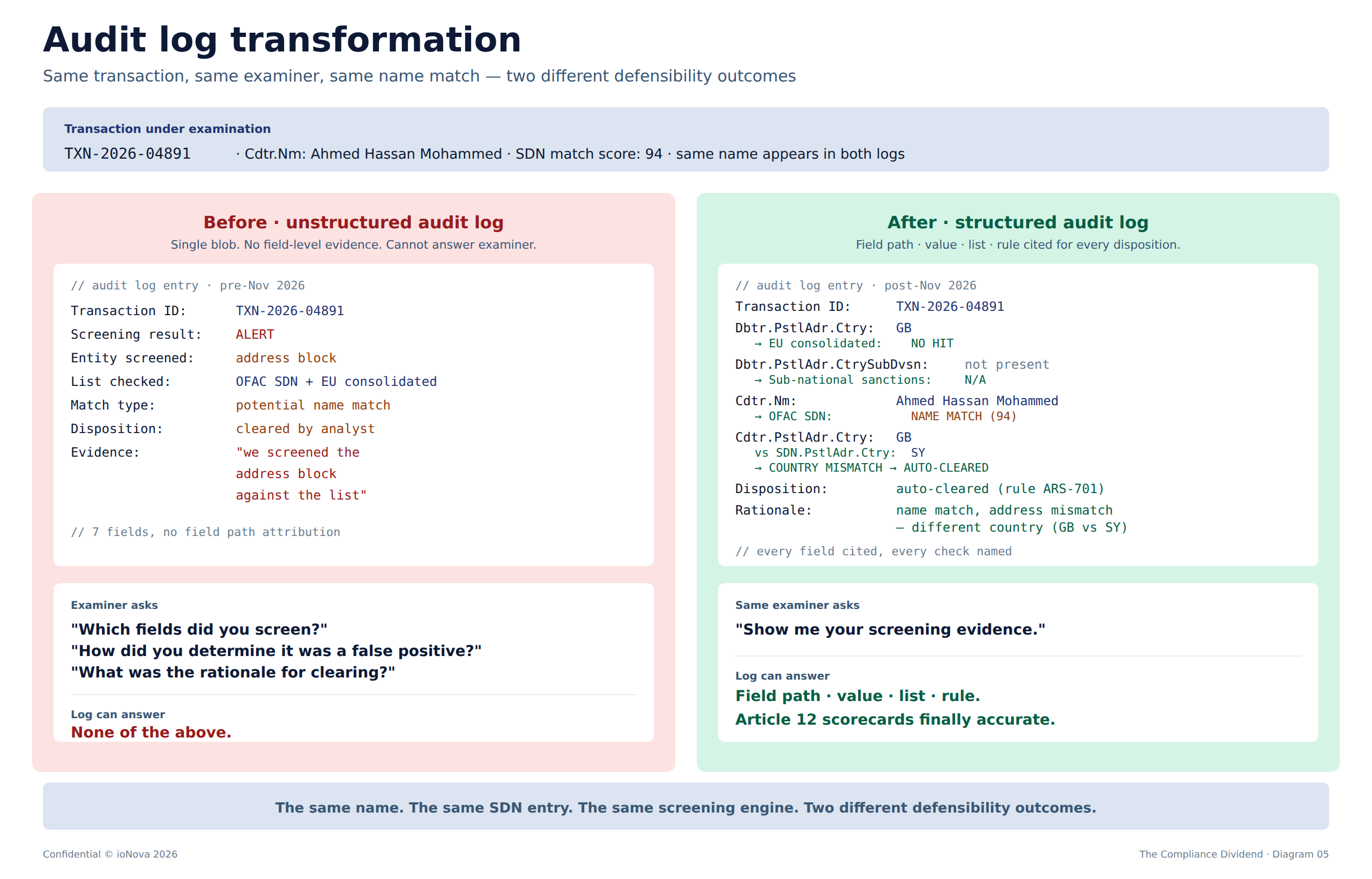
The audit log delta is the clearest moment in the entire dividend. Today's audit entry reads: "address block screened against consolidated list, no hit."
Tomorrow's reads: Cdtr.PstlAdr.Ctry = GB screened against EU consolidated list, no hit at 14:23:08.219
The examiner can audit the screening decision field by field, with timestamps. The fuzzy "we screened it" becomes "we screened these fields, in this order, against these lists, with these outcomes."
"Travel Rule compliance moves from a data-presence obligation — 'we included address text' — to a data-quality obligation — 'every field is tagged, validated, and screenable.'"
Capture-at-source controls — onboarding UI, corporate portal, host-to-host templates, API-level enforcement — keep upstream data quality reliable.
The Compliance Dividend, Tabulated
Here is what the dividend looks like across all four domains, as a single picture.
The screening engine didn't change. The watchlists didn't change. The regulators didn't change.
THE DATA CHANGED.
That sentence is the cleanest summary of the entire transition. It is also the most important sentence for the next audit cycle. Every conversation an MLRO will have with an examiner from late 2026 onward starts with the same question: what did your screening pick up that it could not pick up last year? The honest answer is no longer "we tuned the engine." It is "the engine had better inputs."
That is what changed.
Where Address Resolution Service Fits in the Compliance Stack
ioNova ARS is the resolution layer that makes the dividend reliable. It is not a screening engine; it does not replace the screening engines, transaction monitors, or KYC platforms an institution already runs. It resolves and fixes incoming addresses against postal authority reference data, normalises them to the ISO 20022 <PstlAdr> schema, and feeds them to whichever downstream compliance systems already exist.
Three editions cover the deployment surface area. ARS Treasury for corporate treasury and ERP integrations. ARS Banking for retail and commercial banking originating payments. ARS Transact for correspondent and clearing banks operating across the chain. All three deploy as a sidecar architecture — 10–16 weeks, no core system replacement, sub-20ms P95 latency, SOC 1 Type II certified.
We did not build ARS to be a compliance product. We built it to make the compliance dividend possible — across whichever screening engine, transaction monitor, and KYC platform you already run.
The Generation-Defining Compliance Investment
Every compliance officer I have worked with in the last thirty years has been trained to think of compliance as a cost. The frame is so deeply embedded that we have stopped questioning it.
The November 2026 transition does not change the regulatory burden. It does not lower the cost of running a sanctions team. It does not reduce the headcount in your AML function. What it changes is what your existing infrastructure can do with the data it now receives.
Twenty-five to thirty percent fewer false positives. Auto-clear capability against watchlist addresses. Shell company detection that was architecturally impossible last year. Cross-institutional FIU intelligence that no single bank could see. Audit evidence that finally stands up to examination.
The same investment that satisfies the deadline pays this dividend.
The November 2026 SWIFT enforcement milestone is 196 days away. The institutions that treat it as a compliance project will get the deadline. The institutions that treat it as an infrastructure investment will get the dividend.
Key Takeaways
-
1
One upstream change, four downstream dividends — structured
<PstlAdr>fields transform sanctions screening, AML detection, KYC verification, and Travel Rule compliance simultaneously. The screening engines, watchlists, and regulators don't change. Only the data does. - 2 Sanctions: 25–30% of alert volume becomes auto-clearable — field-level country comparison resolves geographic name collisions (Cuba Street vs Cuba) and name-address confusion (Mohammed Ali Road vs the watchlist person) without analyst intervention.
- 3 AML: shell company detection becomes architecturally possible — address clustering against postal authority reference data makes forty-seven entities at one canonical address visible in the data. They were always there. The unstructured format was hiding them.
- 4 KYC shifts from document collection to substantive verification — structured addresses validated against postal authority data in 246 countries answers "does this resolve?" not just "did we store it?" — the standard FATF Recommendation 10 implies but institutions have been unable to meet.
- 5 Travel Rule: structured fields survive every correspondent hop intact — MT 4×35 truncation strips country, postcode, and city as a payment moves through correspondents. ISO 20022 MX fields are unbounded by design. The institution closest to the sanctions risk finally receives the same data quality as the originator.
-
6
Audit evidence shifts from assertion to field-level proof — "address screened, no hit" becomes
Cdtr.PstlAdr.Ctry = GB screened against EU consolidated list, no hit at 14:23:08.219. Examiners can now verify which fields were checked, against which lists, with which outcome. - 7 The same investment that satisfies the deadline pays the dividend — institutions treating November 2026 as a compliance project will meet the deadline. Institutions treating it as an infrastructure investment will get the compliance dividend across all four domains.
Sources
- SWIFT — Anti-Money Laundering (alert volumes, 90%+ false positive rate)
swift.com/risk-and-compliance/anti-money-laundering - DataRobot — AML Alert Scoring ($30–70 per-alert cost range)
docs.datarobot.com/en/docs/get-started/how-to/biz-accelerators/money-launder.html - LexisNexis Risk Solutions — True Cost of Financial Crime Compliance (Global, 2023)
risk.lexisnexis.com/insights-resources/research/true-cost-of-financial-crime-compliance-study-global-report - PMC / NCBI — Accuracy improvement in financial sanction screening (peer-reviewed, 2024)
ncbi.nlm.nih.gov/pmc/articles/PMC11621073/ - FATF — The FATF Recommendations (updated December 2025)
fatf-gafi.org/en/publications/Fatfrecommendations/Fatf-recommendations.html - FATF — Update to Recommendation 16 on Payment Transparency (June 2025)
fatf-gafi.org/en/publications/Fatfrecommendations/update-Recommendation-16-payment-transparency-june-2025.html - Universal Postal Union — Member states and postal address authority coverage
upu.int/en/Universal-Postal-Union - GeoNames — Geographic database: places named Paris and London worldwide
geonames.org - Paiementor — SWIFT MT103 address field format (4×35 character specification)
paiementor.com/swift-mt103-message-example-with-optional-fields-53b-70-and-71g-explained/ - ModeFin — ISO 20022 transformation: MT standard origin (1977)
modefin.com/iso-20022-the-transformation-from-swift-mt-to-mx-message-formats/